Date: February 18, 2026
Category: CBSE Board Exam Analysis
Reading Time: Deep Dive
Hello to all the students, parents, and teachers out there!
If you are reading this, you have likely just survived or are closely following the massive event that took place yesterday, the CBSE Class 10 Mathematics Board Exam 2026.
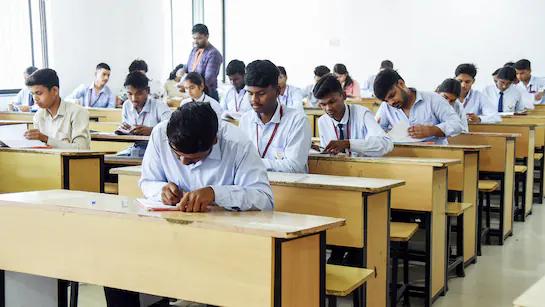
The date was February 17, 2026. The time was 10:30 AM to 1:30 PM. Across the nation, more than 20 lakh students walked into examination centers with their geometry boxes, admit cards, and a whole lot of nervousness. It’s the one paper that usually keeps everyone awake at night, Maths.
Now that the dust has settled and the pens are down, the big question is: How was the paper?
Was it easy? Was it a nightmare? Did the Basic paper live up to its name, or was there a twist? And what is the deal with those MCQs that everyone is talking about?
We have gathered every scrap of news, every teacher review, and the initial student reactions to bring you the ultimate, detailed analysis of the CBSE Class 10 Maths Exam 2026.
Grab a cup of tea (or coffee, if you're prepping for the next exam), and let’s break this down.
The Overall Verdict: Moderate but Lengthy
If we had to sum up the entire exam in three words, based on the reports coming in from exam centers across India, it would be 'Moderate, Conceptual, and Lengthy'.
Unlike some years where students come out crying because the paper was impossible, or dancing because it was a piece of cake, 2026 seems to have found a middle ground. But it wasn't a simple middle ground. It was a paper that tested your brain, not just your memory.
The Big Headline: The MCQ Struggle
The biggest talking point of the 2026 Maths paper wasn't a long 5-mark theorem. It was Section A.
Yes, the Multiple Choice Questions (MCQs).
Usually, students look at MCQs as easy marks. You tick A, B, C, or D, and you move on. But this year? The CBSE threw a curveball.
1. Lengthy Calculations:
Reports from centers confirm that the MCQs were not direct. You couldn't just look at the question and know the answer. You had to solve it. And then solve it some more. Students reported that they spent way more time on the first section than they had planned.
2. No Look and Tick:
In previous years, you might find questions where the answer is obvious if you know the formula. This year, the questions required analysis. You had to understand the logic before you could even pick up your pen to calculate.
3. The Elimination Method Failed:
Smart students often use the elimination method (removing obvious wrong answers) to save time. Teachers noted that the options were framed so closely that you couldn't just eliminate them. You had to do the full math.
This set the tone for the whole exam. If you got stuck in Section A, you were racing against the clock for the rest of the paper.
Deep Dive: The Standard Mathematics Paper
Let's talk about those who opted for Standard Maths. This is usually taken by students who want to pursue Maths in Class 11 and 12.
The Algebra Dominance
According to the initial analysis, Algebra was the king of the paper. It carried significant weightage. If you were strong in Linear Equations, Quadratic Equations, and Polynomials, you probably felt good.
The Conceptual Shift
We saw a quote from an Ex-ISRO scientist, Gurpreet Singh, which really sums up the Standard paper. He noted that the paper "tested thinking, not memorization."
This is a huge shift. The CBSE is moving towards "Competency-Based Education." What does that mean for you?
- It means rote learning formulas didn't help much.
- You needed to understand structure.
- For example, instead of just solving a polynomial, you had to understand polynomial behavior.
- In Geometry, it wasn't just about proving a theorem, it was about visualizing the shape structure.
Teacher's Take on Standard Maths:
Teachers from schools like Seth M.R. Jaipuria Schools and DPS mentioned that the paper closely followed the NCERT syllabus. This is good news! It means the board isn't asking questions from random outer space books. If you did your NCERT thoroughly, you were safe.
However, they also mentioned that the Assertion-Reasoning questions were slightly tricky. These require very logical reading. You can't rush through them.
Deep Dive: The Basic Mathematics Paper (The Surprise Twist!)
Now, this is where things get interesting. Usually, Basic Maths is assumed to be... well, basic. Simple. Direct.
But the 2026 Basic Maths paper had other plans.
Trickier Than Standard?
In a surprising turn of events, some teachers analyzed that the Basic paper was actually trickier in some sections than the Standard paper!
Tanmay Das, a PGT Mathematics teacher, pointed out a specific issue with the Circles chapter.
There’s more to life than simply increasing its speed.
By Udaipur Freelancer
- The questions on Circles in the Basic paper were not straightforward.
- They introduced a tricky twist that required higher-order thinking skills.
- This was unexpected for students who chose Basic Maths expecting an easier ride.
Probability Questions:
Here is a comparison that teachers noted:
- In Standard Paper: The Probability question was formula-based (Direct).
- In Basic Paper: The Probability question required data interpretation. You had to read a paragraph or look at data, understand it, and then solve.
Geometry in Basic:
Even in Geometry, questions required multi-step reasoning. It wasn't just "Step A -> Answer." It was "Step A -> Step B -> Logic -> Answer."
So, if you took Basic Maths and felt it was a bit hard, don't worry you weren't imagining it. Even the experts agree with you.
Section-by-Section Breakdown
Let's break down the structure of the paper based on the feedback from students and experts.
Section A: The Time Eaters (MCQs)
- Difficulty: Moderate to Hard.
- Main Issue: Length. They took too long to solve.
- Tip: This section tested patience.
Section B: Short Answers
- Difficulty: Easy to Moderate.
- Content: Mostly direct NCERT-based questions.
- Vibe: This was the relief section for many students.
Section C: Short Answers (3 Marks)
- Difficulty: Moderate.
- Focus: Logic. Teachers noted that these questions fell into the moderate category but you had to show your steps clearly.
Section D: Long Answers (5 Marks)
- Difficulty: Moderate but Conceptual.
- Key: Deep knowledge. You couldn't fake your way through these. You needed to know the concepts of Algebra and Geometry inside out.
- Good News: Step-wise marking will save many students here.
Section E: Case-Based Questions
- Difficulty: Application-based.
- Theme: Real-life situations.
- Feedback: These were manageable if you didn't panic at the length of the text. They tested if you can apply math to the real world (like calculating areas for a project or money management).
What Changed from Previous Years? (2025 vs. 2026)
If we compare this year's paper to the papers from 2024 or 2025, there is a clear pattern emerging.
1. Less Reliance on Direct Formulas
In the past, you could memorize x = -b ± √... and survive. This year, the questions asked you to recognize patterns first.
2. Speed vs. Understanding
Previously, speed was the main enemy. If you wrote fast, you won.
This year, Thinking was the main enemy. The 'Ex-ISRO scientist' analysis mentioned that the length of the exam was optimal to allow for deep thinking. It reduced the advantage of students who just practice mechanical problem solving.
3. Competency-Based Assessment
The Board is serious about this. Questions on Cyclic Quadrilaterals and Polynomial Behavior were framed to test if you really get it, not just if you can calculate it.
Student Reactions: Cheers and Tears
As soon as the clock struck 1:30 PM, the scenes outside exam centers were mixed.
The Happy Crowd:
- "It was all NCERT!"
- "I practiced the sample papers, so I knew the pattern."
- "Section B and C saved me."
The Worried Crowd:
- "I couldn't finish Section A in time."
- "The Circles question in Basic Maths confused me."
- "I missed one 5-mark question because I was too slow."
One report described the scene perfectly: "Cheer and Tears as Students React to Results." Some were high-fiving, others were quietly calculating how many marks they might lose.
Important Update: On-Screen Marking
There is another piece of news that came out around exam time. The CBSE is introducing On-Screen Marking for Class 12 answer sheets this year.
While this applies to Class 12 right now, it shows a massive shift in how the board works.
- How it works: Answer booklets are scanned. Examiners check digital copies on a screen.
- Why? It reduces totaling errors (no more adding marks wrong!). It speeds up results.
- For Class 10: While your paper might still be checked physically (or digitally, depending on the region), this shows the system is becoming more transparent and accurate.
Post-Exam Survival Guide: What to Do Now?
Okay, Maths is over. Breathe.
1. The Reset Strategy
Experts are advising students to stop analyzing the paper.
- Don't check YouTube for Answer Keys immediately. It just creates panic.
- If you found a mistake you made, you can't change it now. Let it go.
- Take a Break: Teachers suggest a short mental break. Sleep. Hydrate. Your brain just ran a marathon.
2. What if you missed the exam?
There was an update regarding students who might miss a paper due to valid medical reasons. The CBSE has guidelines for Essential Repeat or allowing chances depending on the specific case. But generally, if you missed it without a valid, documented reason, it's a problem. Always follow official updates.
3. Worried about Marks?
If you feel you did really badly, remember:
- Step Marking: You get marks for steps, even if the final answer is wrong.
- Verification: After results, you can apply for verification of marks.
- Compartment Exams: If the worst happens, there is always a second chance with compartment exams in the same academic year.
The Road Ahead: Next Exams
You don't have much time to relax. The train keeps moving.
Next Stop: English
For many, the next major papers are English Communicative or English Language and Literature.
- Tip: English is a scoring subject. Use it to boost your overall percentage.
Don't Forget: Physical Education & Home Science
Some students have Physical Education or Home Science coming up.
- PE Tips: Focus on high-weightage theory sections like Sports Science and Biomechanics. Revise definitions and diagrams (like asanas). It's a 90-minute theory paper, so balance speed and accuracy.
Conclusion: You Did It!
Writing the Class 10 Maths Board Exam is a rite of passage for every Indian student. It’s a tough day, but you got through it.
Whether you think you scored 95 or you are praying for 40, be proud that you prepared and showed up.
Key Takeaways for Future Batches (Class of 2027):
- Don't ignore NCERT. It is your bible.
- Practice MCQs. Don't treat them as easy marks. Treat them as mini-problems.
- Understand, Don't Memorize. The Board is changing. You need to understand the logic behind the math.
- Basic isn't always Easy. If you pick Basic Maths, study just as hard.
Good luck for the rest of your exams!















Recommended for you
Must-See Art Exhibitions Around the World This Year
The Revival of Classical Art in a Digital Age
Breaking Down the Elements of a Masterpiece Painting
The Revival of Classical Art in a Digital Age