If you are from Kolkata, or even if you have just visited the City of Joy for a few days, there is one scent that you simply cannot ignore. It is the aroma of ghee, saffron, and tender meat wafting through the air near New Market. It is the smell of history. It is the smell of Aminia.
When we talk about Biryani in Kolkata, the conversation often starts and ends with Aminia. But have you ever wondered how this massive food empire actually began? It wasn’t always the giant restaurant with air-conditioning and waiters in uniform.
Believe it or not, this legendary institution started as a tiny, humble food stall.
Today, we are going to take a deep dive into the incredible history of Aminia. From a soldier in the British Indian Army to a modern-day brand dreaming of Australia and Singapore, this is a story of resilience, taste, and the love of good food.
From a Small Town in Lucknow to the Streets of Kolkata
To understand the magic of Aminia, we have to travel back in time. We need to go back way before the busy streets of modern Kolkata. We need to go to a small town called Dariabad, located near Lucknow in Uttar Pradesh.
This is where the story begins with a man named Abdul Rahim.
Abdul Rahim was not a chef originally. He was a sepoy (a soldier) in the British Indian Army. In the early 1900s, being a soldier was a tough job. But Abdul Rahim was a man with a vision. According to his great-grandson, Kabir Azhar (who is the current fourth-generation owner), Abdul Rahim made a very bold decision.
In those days, once you enlisted in the army, it wasn't easy to just leave. You served your time. But Abdul Rahim decided to leave the uniform behind. He wanted to do something different. He wanted to cook.
He packed his bags and traveled to Calcutta (now Kolkata). He settled in a bustling area called Machua Bazar in the Burrabazar district. He didn't have a big building or a lot of money. He started modestly.
In 1929, he set up a small food cart.
Imagine that for a second. The year is 1929. The world is different. The streets of Calcutta are filled with hand-pulled rickshaws and trams. And there, on a street corner, is Abdul Rahim, selling Kebabs and Roti to passersby.
He cooked the food in the traditional Awadhi style the style of cooking famous in Lucknow. It was rich, flavorful, and cooked with patience. The people of Calcutta loved it.
The Second Generation: Moving from a Cart to a Proper Restaurant
Abdul Rahim had two sons. While he started the business, it was the younger son, Abdul Qayyum, who really pushed the family toward greatness.
Kabir Azhar shares a lovely family memory about this. He says his grandfather, Abdul Qayyum, was always the favorite. It was Abdul Qayyum who looked at the small food cart and said, We need more. He insisted that his father, Abdul Rahim, move from a simple stall to a proper restaurant.
So, the family took a leap of faith. They established the first physical Aminia Restaurant on Zakaria Street.
This wasn't just a place to grab a quick bite anymore. It was a place to sit and savor the food. They served Biryani, slow-cooked Kormas, and tender Kebabs. The reputation of Aminia began to grow. People weren't just eating food. they were tasting the heritage of Lucknow right in the heart of Bengal.
August 15, 1947: A Historic Opening on Independence Day
Now, this is where the story gets truly cinematic.
Fast forward to August 15, 1947.
If you know your history, you know this is the most important date in Indian history. It was the day India gained Independence. It was also the day Pakistan was born. The whole country was in a state of chaos, joy, confusion, and hope.
The newspapers that morning were historic. The Morning News carried massive headlines: "SOVEREIGN PAKISTAN AND INDIA BORN." There were stories about Mahatma Gandhi, about Muhammad Ali Jinnah, and about the British leaving.
But if you looked closely at the bottom left corner of that very same newspaper on that very same historic day, there was a small advertisement.
It read:
"ANNOUNCEMENT: Thank God AMINIA HOTEL is opening a branch at Old Hindustan Building near New Market on the auspicious day of Id-ul-Fitr. We expect our patron's appreciation as usual."
Talk about perfect timing!
While the world was focused on the birth of nations, a restaurant was expanding. This new branch in New Market would go on to become the flagship store the one that everyone knows today.
Kabir Azhar notes the irony and beauty of this. He says, "In a moment defined by the birth of nations, a restaurant’s expansion nonetheless found its place in the headlines. This was, after all, Calcutta."
For Anwar Hamid, a regular customer at Aminia, this history adds a special flavor to the food. He says that walking into the New Market outlet feels like walking into heritage. The building itself (Futnani Chambers) was once home to former West Bengal Chief Minister Jyoti Basu during his early years. When you eat at Aminia, you are eating in a place that has seen the history of India unfold.
The Calcutta Biryani: What Makes it Special?
Okay, let's talk about the food. Specifically, the Biryani.
If you ask a food lover in India about Biryani, you will start a war. There is the Hyderabadi Biryani, the Lucknowi Biryani, and the Kolkata Biryani.
So, what makes the Kolkata Biryani at Aminia so different?
Kabir Azhar explains it simply: It’s about the meat.
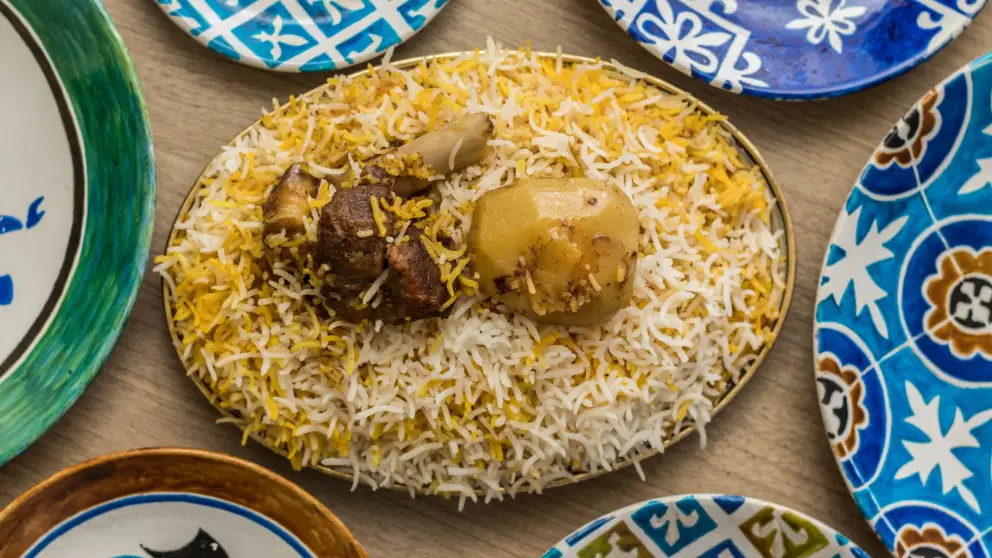
In a typical Hyderabadi biryani, the meat is often cut into smaller pieces and mixed throughout the rice. But in Kolkata, and specifically at Aminia, they serve a single, giant piece of meat.
Kabir laughs and says, "Bengalis believe the bigger the piece, the happier you are." This generous cut of meat defines the dish. It melts in your mouth.
There’s more to life than simply increasing its speed.
By Udaipur Freelancer
The Spice Game
Then there is the masala (spices).
- Hyderabadi Style: Uses a lot of curry leaves, black pepper, and is generally spicier and heavier.
- Aminia (Kolkata) Style: It is much subtler. They use white spices. It is more aromatic than spicy. You can smell the rose water, the sweet attar, and the saffron. It doesn't hit you with heat, it hits you with fragrance.
The Rice
The visual appeal is also different. Aminia uses long-grain basmati rice. Kabir explains that the visual elegance of long, slender rice is central to the appeal. It looks royal.
The Potato Debate
Now, we have to address the elephant in the room: The Potato.
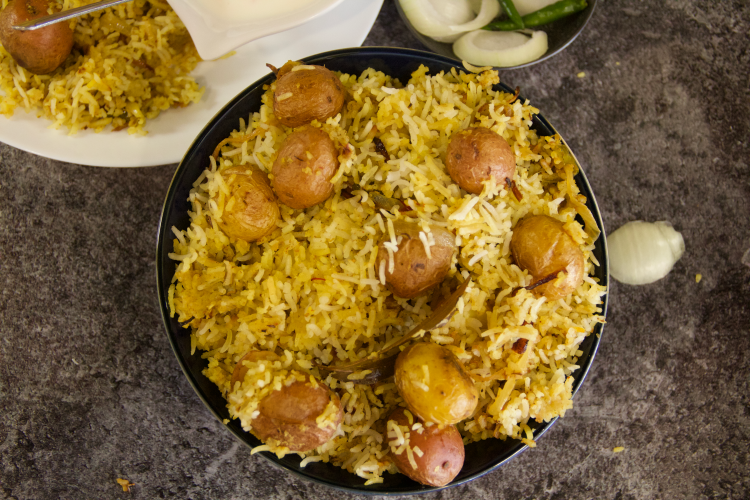
To an outsider, putting a potato in a meat biryani seems crazy. But to a Kolkata local, a biryani without a potato is a tragedy.
There is a famous legend about Wajid Ali Shah, the Nawab of Awadh who was exiled to Calcutta by the British in 1856. The popular story goes that the Nawab was short on money, so his chefs added potatoes to the biryani to bulk it up and save money on meat.
However, Kabir Azhar politely disagrees with this poverty theory.
He believes the potato wasn't added because they were poor. It was added because it was an exotic vegetable at the time! In the 1800s, potatoes were new and trendy in India. The chefs used it as a delicacy.
At Aminia, the potato is treated with as much respect as the meat. It is golden, fried to perfection, and steeped in the meat juices. It absorbs all the flavor. For many customers, the potato is actually the best part of the dish!
The No Egg Rule
Here is a fun fact, Many Kolkata biryani places serve a boiled egg along with the meat and potato.
Aminia does not.
Kabir Azhar maintains that the egg distracts from the flavor. He suggests a simple formula for the best taste, "Take a little mutton, a bit of potato, and some rice." That is the perfect bite. No egg needed.
A Fusion of Cultures: When Awadh Met Bengal
Aminia is an Awadhi restaurant, but it is located in Bengal. Over nearly 100 years, the two cultures have blended together in the kitchen.
Kabir shared some fascinating culinary secrets about how they adapted their recipes for the Bengali palate.
1. The Magic of Poppy Seeds (Posto)
In Lucknow, the stews and gravies are rich and heavy. But in Bengal, people love poppy seeds, known locally as Posto.
Aminia introduced a distinctive sheen to their gravies by adding poppy seed paste. This gives the dish a creamy texture and a very subtle sweetness that Bengalis adore. This turned their Rezala (a white yogurt-based meat stew) into an iconic dish.
2. The Rice Switch for Dessert
In Lucknow, the dessert Phirni (a ground rice pudding) is traditionally made with ground Basmati rice.
But at Aminia, they made a switch. They started using Gobindobhog rice.
Gobindobhog is a short-grain, incredibly aromatic sticky rice grown in Bengal. By using this local rice, the Phirni at Aminia became creamier and more fragrant than the original version.
It is a perfect example of how migration creates new and delicious things. It is Lucknowi soul with a Bengali heart.
Survival: Overcoming the Tough Times
It hasn't always been smooth sailing for Aminia.
The late 20th century was a very difficult time for businesses in Calcutta. In the 1960s and 70s, the city was gripped by political unrest and radical trade unionism.
Labor unions were very powerful and often aggressive. Kabir recalls that most old-time restaurants in Calcutta were plagued by these unions. They dictated terms that restricted how businesses could run.
The impact was severe. Aminia actually had a branch on Southern Avenue that was forced to close down because of these labor troubles. It remained closed for years.
But the family didn't give up. They held on to their flagship New Market store. They weathered the storm. Eventually, as the political climate changed, they bounced back. The Southern Avenue branch was finally reopened in 2010 or 2011, marking a victory for the family's resilience.
The Modern Era: 97 Years and Counting
Today, Aminia is run by the 3rd and 4th generations of the family. Mohammed Azhar (3rd generation) and his sons, Kabir Azhar and Asher Azhar, are at the helm.
They have come a long way from Abdul Rahim’s food cart.
Currently, Aminia has 12 outlets across Kolkata, and they have expanded to nearby cities like Siliguri and Guwahati. They even have a branch in Dubai!
Kabir notes that 70 percent of their customers are Bengalis. The brand has become synonymous with celebrations. During Durga Puja (the biggest festival in Bengal), the lines outside Aminia are insane. It is a tradition for families to go pandal-hopping and then end the night with Aminia biryani.
The Future: Taking Kolkata Biryani Global
So, what is next for this historic brand?
Kabir Azhar is young and ambitious. He studied in Australia and Singapore, and he noticed something there. He saw that while Hyderabadi Biryani is famous globally, Kolkata Biryani hasn't quite made its mark on the world stage yet.
He wants to change that.
"I want to open in Singapore and Australia," Kabir shares. "I want Calcutta to be known for its biryani, just like Hyderabad or Lucknow."
Conclusion: More Than Just Rice and Meat
Aminia is not just a restaurant. It is a timeline of Kolkata’s history.
- It started when the British were still in charge.
- It expanded on the very day India became free.
- It survived the political turmoil of the 70s.
- And now, it is looking to take over the world.
For the people of Kolkata, Aminia is an emotion. It is the memory of holding your grandfather's hand and walking into the New Market branch. It is the sound of plates clinking. It is the taste of that soft, golden potato that melts in your mouth.
From a sepoy who dared to quit the army to a modern business empire, Aminia proves that if you cook with passion and stay true to your roots, you can create a legacy that lasts forever.
So, the next time you find yourself in Kolkata, don't just eat the biryani. Take a moment to savor the history on your plate.













Recommended for you
Must-See Art Exhibitions Around the World This Year
The Revival of Classical Art in a Digital Age
Breaking Down the Elements of a Masterpiece Painting
The Revival of Classical Art in a Digital Age