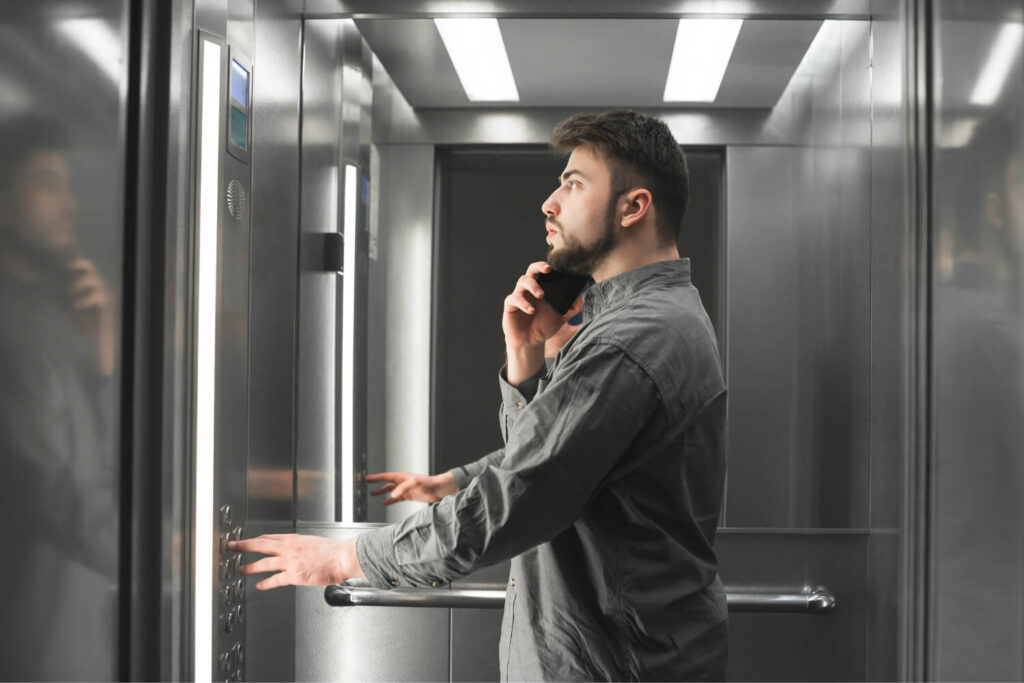
We have all been there. You are in the middle of an important phone call, or perhaps you are just about to send that crucial email. You step into the elevator, the heavy metal doors slide shut, and immediately, your voice cuts out. You look down at your screen, and those glorious five bars of 5G have been replaced by the dreaded No Service or the classic Google Chrome No Internet dinosaur.
Despite living in an era of advanced satellite communications and lightning-fast 5G networks, the humble elevator remains the ultimate nemesis of the smartphone.
Why does the building’s lift consistently turn into a dead zone? Is it a conspiracy by cellular providers? A glitch in your phone? The truth actually lies in the fundamental laws of physics and modern architecture. Read on, because the real reason elevators turn into no-signal zones for your smartphone might surprise you.
The Science of the Silence: Electromagnetic Waves
To understand why your phone loses its mind in an elevator, we first have to understand how it communicates with the outside world. Your smartphone is essentially a highly sophisticated two-way radio. It sends and receives information using radio frequency (RF) signals, which are a type of electromagnetic wave.
These invisible waves travel through the air between your device and the nearest cell tower. As long as there is a relatively clear path, you get a strong signal. However, electromagnetic waves have a major weakness, they are easily disrupted, absorbed, or reflected by dense physical obstacles.
This brings us to the anatomy of an elevator, which is practically custom-built to be the ultimate signal-killer.
The Culprits: What Exactly is Blocking Your Signal?
As highlighted in recent technology reports, the sudden drop in connectivity is directly related to the construction materials used to build both the elevator cabin and the shaft it travels in. Let’s break down the primary offenders:
1. The Faraday Cage Effect and Heavy Metals
The most significant reason your phone loses signal is a phenomenon known in physics as a Faraday Cage. A Faraday Cage is an enclosure made of conductive material (like metal) that blocks external static and non-static electric fields.
Think about the interior of a standard elevator. It is essentially a giant metal box. The walls, ceiling, and doors are typically constructed from stainless steel and other heavy metals. When electromagnetic waves (your cell signal) hit this highly conductive metal box, the metal reflects the waves away rather than letting them pass through. The signal bounces off the exterior of the elevator, leaving the inside a complete void of cellular reception.
2. Reinforced Concrete and Cement
It isn't just the elevator car itself that is the problem, it is the shaft it moves through. To ensure structural integrity and fire safety, the core of a building (where the elevator shafts are located) is heavily reinforced.
The shaft is usually built using thick, high-density concrete and cement, laced with an intricate grid of steel rebar. While glass and drywall allow radio waves to pass through relatively easily, thick concrete absorbs radio frequencies, while the steel rebar reflects whatever is left. By the time a cell tower’s signal penetrates the exterior walls of the building, navigates through the concrete shaft, and hits the metal elevator car, there is virtually zero signal left to reach your phone's antenna.
3. The Underground Dilemma
Have you noticed that you lose signal even faster when taking an elevator down to a parking garage? Underground lifts face an compounded connectivity issue.
There’s more to life than simply increasing its speed.
By Udaipur Freelancer
When an elevator descends below ground level, it isn't just fighting steel and concrete, it is fighting the earth itself. Dirt, rock, and subterranean moisture are incredibly dense barriers. Radio frequencies struggle to penetrate deep underground, meaning that even if the elevator doors are open in a basement lobby, you still might find yourself in a no-signal zone.
Can This Problem Be Fixed? (The Role of Network Boosters)
Given how reliant we are on smartphones, building developers and network providers are actively looking for solutions to this dead-zone dilemma. If you have ever been in a high-end commercial building or a modern luxury hotel where your signal doesn't drop in the lift, it isn't magic it's technology.
Installing Network Amplifiers:
It is absolutely possible to maintain a signal inside an elevator, but it requires deliberate engineering. Building managers can install cellular repeaters or network boosters inside the building.
More specifically, technicians can run a leaky feeder cable a type of coaxial cable that acts as an extended antenna all the way up and down the elevator shaft. This cable captures the cellular signal from a donor antenna on the roof and broadcasts it directly into the shaft, allowing the signal to penetrate the elevator car. However, installing these systems is expensive, requires permissions, and involves complex engineering, which is why they aren't standard in older or standard residential buildings.
Wi-Fi Calling as a Workaround:
As an alternative, some modern buildings blast high-speed Wi-Fi throughout their elevator shafts. If your smartphone has Wi-Fi Calling enabled, your phone will seamlessly transition your call from the cellular network to the internet network, preventing the call from dropping when the metal doors close.
Survival Guide: What to Do If You Get Stuck
While losing your TikTok feed for 30 seconds during a ride to the 5th floor is just a mild annoyance, being in a no-signal zone becomes a genuine concern if the elevator breaks down.
If you ever find yourself stuck in a lift with no bars on your phone, do not panic. Modern elevators are designed with this exact scenario in mind.
- Do Not Rely on Your Cell Phone: Accept that your smartphone is temporarily useless for making outside calls. Staring at the No Internet dinosaur game won't bring the signal back.
- Use the Emergency Intercom: Look for the emergency call button on the elevator's control panel (usually marked with a bell symbol). This button is hardwired directly into the building’s communication system or a 24/7 monitoring service. It does not rely on cellular towers and will work even in a Faraday cage.
- Wait it Out: If you just experience a dropped call during a normal ride, simply wait until the doors open at your destination. Once you step out of the metal enclosure and away from the concrete shaft, your phone's antenna will quickly reconnect with the nearest cell tower.
Conclusion
The next time your phone call abruptly ends the moment you step into a lift, you don't need to be frustrated with your network provider or assume your smartphone is broken. You are simply witnessing the unyielding laws of physics in action. The heavy metals, thick concrete, and stainless steel required to keep you safe as you travel hundreds of feet in the air are the exact same materials that create an impenetrable fortress against electromagnetic waves.
Until network boosters become a mandatory building code standard globally, the elevator will remain one of the last few guaranteed digital quiet zones in our modern world.















Recommended for you
Must-See Art Exhibitions Around the World This Year
The Revival of Classical Art in a Digital Age
Breaking Down the Elements of a Masterpiece Painting
The Revival of Classical Art in a Digital Age