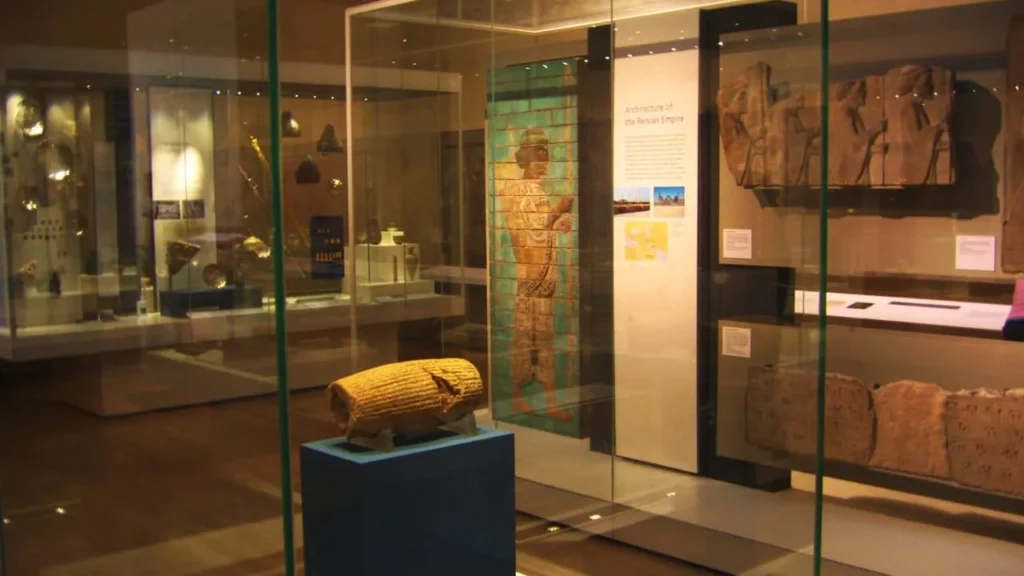
In the hallowed halls of the British Museum sits a small, football-sized barrel of baked clay. To the casual observer, it looks like a broken relic of a forgotten time. However, covered in dense Akkadian cuneiform script, this artifact the Cyrus Cylinder carries a voice that screams across 2,600 years of history.
It is a voice of tolerance, freedom, and dignity. And today, that ancient voice stands in stark, haunting contrast to the harsh realities of modern-day Iran.
From the opulent excesses of the Shah to the iron-fisted rule of the current Islamic Republic, the land that gave the world its 'first charter of human rights' has become a tragic theater of oppression. But how does a clay cylinder from the 6th century BC continue to shame the rulers of Tehran?
The First Charter of Human Rights
To understand the irony of modern Iran, we must look back to 539 BC. Cyrus the Great, the founder of the Achaemenid Empire, had just conquered Babylon. In the ancient world, conquest usually meant slaughter, enslavement, and the destruction of local gods.
Cyrus chose a different path.
As inscribed on the cylinder, he did not impose his religion. He did not burn temples. Instead, he declared peace. He allowed displaced communities most famously the Jews exiled in Babylon to return to their homelands and rebuild their sanctuaries. He prohibited his army from terrorizing the population.
In 1971, the UN recognized the text as a "precursor to the Universal Declaration of Human Rights." It was a testament to the idea that a ruler’s legitimacy comes not from fear, but from the welfare of the subjects.
The Shah’s Million-Dollar Irony
Fast forward to 1971. Mohammad Reza Pahlavi, the Shah of Iran, decided to throw the party of the century in the desert ruins of Persepolis to celebrate 2,500 years of the Persian Empire.
It was a spectacle of unimaginable luxury. Silk tents were flown in from Europe, food was catered by Maxim’s of Paris, and royalty from across the globe gathered to toast the Shah. He styled himself as the 'New Cyrus,' using the Cylinder as a prop to legitimize his Pahlavi dynasty.
There’s more to life than simply increasing its speed.
By Udaipur Freelancer
However, the Cylinder exposes hypocrisy just as well as it proclaims liberty. While the Shah celebrated Cyrus’s message of freedom, his own people were suffering under poverty and the repression of his secret police. The Shah embraced the image of Cyrus but betrayed his principles. This vulgar display of luxury, juxtaposed with political repression, fueled the anger that would eventually explode into the 1979 Islamic Revolution.
The Islamic Republic: A New Tyranny
The Shah fell, but the curse of the Cylinder remained. The Islamic Republic, led first by Ayatollah Khomeini and now Ali Khamenei, initially viewed pre-Islamic history with suspicion, dismissing the Cylinder as a relic of monarchy.
Yet, history has a way of repeating itself. Today, the regime faces the same accusations that toppled the Shah, but on a bloodier scale. As weeks-long protests rock the nation, reports indicate that thousands have been killed and tens of thousands jailed. The internet the modern voice of the people is frequently shut down to hide the violence.
The irony is palpable. The very land where the concept of human dignity in governance was first etched into clay is now governed by a theocracy that enforces strict ideological compliance through force.
The Unspoken Curse
The Cyrus Cylinder serves as an uncomfortable mirror for Tehran. It reminds the world that authoritarianism is not an inherent trait of Iranian history. in fact, the region invented the alternative.
The artifact proves that 2,600 years ago, a Persian king understood that true power requires respect for the people. By ignoring this ancestral wisdom, modern rulers whether wearing a crown or a cleric’s robe invite their own downfall.
As the source material suggests, the Shah invoked the name of Cyrus while ignoring his ideals, and he fell. Will the Islamic Republic, which violates those ideals daily, meet the same fate? The Cylinder sits quietly in London, but its message is louder than ever: Tyranny in Persia is a betrayal of its own soul.















Recommended for you
Must-See Art Exhibitions Around the World This Year
The Revival of Classical Art in a Digital Age
Breaking Down the Elements of a Masterpiece Painting
The Revival of Classical Art in a Digital Age