We often hear the saying, "What's in a name?" Well, the Indian government seems to be putting that to the test. There's big news buzzing around one of the world's largest employment schemes, MNREGA. The plan is to give it a brand-new name and a slight upgrade.
But the real question on everyone's mind is simple. Will a new name change the ground reality for millions of rural workers who depend on this scheme for their livelihood? Let's dive in and understand what's happening.
From MNREGA to VB G RAM G: What's Changing?
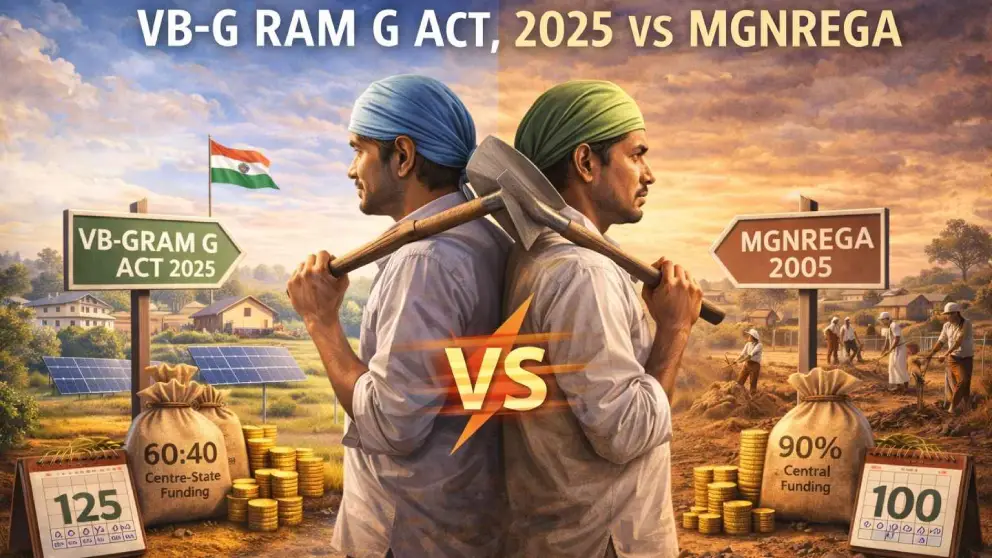
First, let's get the names straight. MNREGA, which stands for Mahatma Gandhi National Rural Employment Guarantee Act, has been a lifeline for rural India for years. It promises 100 days of paid work per year to any rural household that wants it.
The proposed new name is 'Vishwakarma Bharatiya Gramin Rozgar Abhiyan aur Mazdoori Guarantee' (VB G RAM G).
Along with the new name, there's another change on the table. the government plans to increase the guaranteed workdays from 100 to 125 days per year.
On the surface, this sounds like a positive step. More work means more income, right? But to understand if this will truly make a difference, we need to look at how the scheme is actually working right now.
The Reality Check: A Promise vs. Performance
The promise of 100 days of work is the heart of MNREGA. But how many families actually get this full quota? The numbers might surprise you.
According to a report by the Centre for Economic Data and Analysis (CEDA) and Ashoka University, the reality is quite different from the promise. In the last five years:
- Only 50.25 lakh households received the full 100 days of work.
- This is just 4% of the total families who demanded work under the scheme.
Think about that. For every 100 families asking for the promised 100 days of work, only 4 are actually getting it. This shows a huge gap between what the scheme promises and what it delivers.
A Tale of Two Indias: The State-by-State Report Card
The performance of MNREGA isn't the same across the country. Some states are doing a much better job than others at providing employment.
States Doing Relatively Well:
Some states in the Northeast are leading the way.
There’s more to life than simply increasing its speed.
By Udaipur Freelancer
- Mizoram: Provides an average of 66.92 days of work.
- Meghalaya: Provides an average of 68.3 days of work.
- Nagaland: Provides an average of 64.29 days of work.
States That Need to Catch Up:
On the other hand, some of the country's largest states are lagging far behind.
- Gujarat: Provides an average of just 22.95 days of work.
- Uttar Pradesh: Averages around 37.16 days.
- West Bengal: Averages around 28.97 days.
This data clearly shows that the problem isn't uniform. The challenge is to figure out why some states are struggling so much to provide even half of the promised workdays.
Is There a Better Way Forward?
So, if a name change and 25 extra days aren't the complete solution, what is?
One interesting idea being discussed is to link MNREGA work with agriculture. Imagine if the work done under the scheme could directly support farming activities. This could provide more consistent work for labourers throughout the year and also help boost our agricultural sector. It could also lead to better wages, potentially increasing the daily pay from the current rates to around ₹300-₹350.
Conclusion: More Than a New Name is Needed
Changing MNREGA's name to 'VB G RAM G' and increasing the workdays to 125 is a welcome thought. But it feels like changing the cover of a book without editing the pages inside.
The real problems with the scheme are much deeper:
- Failure to provide the promised 100 days of work.
- Delays in wage payments.
- Wages that are often too low to support a family.
For the millions of rural families who look to this scheme with hope, the name on the signboard doesn't matter. What matters is the guarantee of work, timely payment, and a wage that gives them dignity.
The real challenge for the government is not to just rebrand the scheme, but to fix the system from the ground up. Only then will the promise of rural employment truly become a reality for everyone.













Recommended for you
Must-See Art Exhibitions Around the World This Year
The Revival of Classical Art in a Digital Age
Breaking Down the Elements of a Masterpiece Painting
The Revival of Classical Art in a Digital Age