In a significant legal and social development, the Gujarat state government has initiated a move to amend the Gujarat Registration of Marriages Act, 2009. The proposed changes, which have sparked widespread conversation across the nation, aim to make parental consent mandatory for the registration of love marriages.
Citing the protection of the state's daughters and a crackdown on the alleged practice of Love Jihad, the Gujarat government is positioning this amendment as a necessary armor for young women. But what exactly does this proposal entail, and what triggered this decision?
Let’s dive deep into the details of the proposal, the arguments presented by Deputy Chief Minister Harsh Sanghavi, and the potential impact on marriage laws in the state.
The Core Proposal: Parental Consent as a Shield
At the heart of this controversy is a proposed amendment to the marriage registration laws in Gujarat. According to reports, the state government is moving to introduce a provision that would make the consent of parents compulsory for the registration of a marriage.
This move is not occurring in a vacuum. It is explicitly linked to the government’s stance on preventing fraudulent marriages where identity is concealed a phenomenon often politically termed as Love Jihad.
The Salim becomes Suresh Argument
Deputy Chief Minister Harsh Sanghavi, speaking on the issue, did not mince words regarding the motivation behind the amendment. Addressing the state Assembly, Sanghavi highlighted that a game is being played under the guise of love.
"If any Salim changes his identity and becomes Suresh to trap innocent girls, he will be taught a lesson," Sanghavi stated, emphasizing the government's resolve.
The government argues that this law is not about controlling who marries whom, but rather about ensuring transparency and protecting young women from deceit. Sanghavi termed the amendment a matter of "public importance," stressing that the administration is preparing these changes to "protect the dignity of girls and Sanatan Dharma."
What Triggered the Move? The Gandhinagar Case Study
To bolster the argument for mandatory parental consent, the government cited specific anomalies in marriage registrations. Harsh Sanghavi pointed to cases from the Gandhinagar district as a prime example of why the system needs an overhaul.
According to the Deputy CM, there were instances in Gandhinagar where:
- Not a single Muslim resided in certain areas.
- Yet, hundreds of Nikah certificates were issued from those very locations.
This discrepancy has raised red flags within the administration, suggesting that loopholes in the current registration system are being exploited to facilitate marriages based on fraudulent grounds or hidden identities. The government posits that involving parents in the legal process will act as a verified checkpoint against such anomalies.
The Proposed Process: WhatsApp Alerts and 30-Day Waits
The proposed amendment introduces a modern, albeit controversial, twist to the bureaucratic process of marriage registration. The government isn't just asking for a signature. they are integrating digital communication to ensure parents are in the loop.
Here is a breakdown of the proposed registration system detailed in the reports:
1. The WhatsApp Notification System
In a move to ensure parents cannot be kept in the dark, the proposal suggests that once a marriage registration application is submitted, the parents of both the bride and the groom will be officially informed.
- This notification will happen via a WhatsApp message.
- It will be sent within seven working days of the Assistant Registrar confirming the application.
- Notices may also be sent electronically or physically, depending on feasibility.
2. The 30-Day Waiting Period
The days of quick registration might be over. Under the proposed regulations, the registration of a marriage will take at least 30 days. This cooling-off period is presumably designed to allow time for the verification of documents and to let families respond to the notification.
3. Strict Documentation
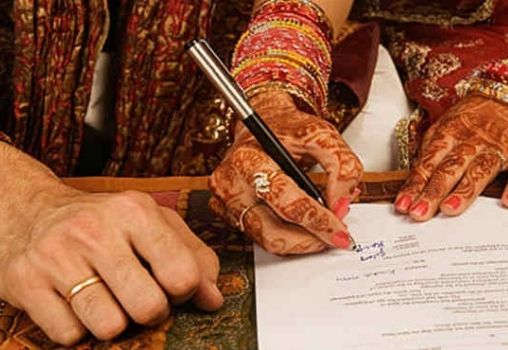
Every marriage registration application will need to be submitted to the Assistant Registrar of the respective jurisdiction. The paperwork requirements are stringent:
- Signatures of both parties and two witnesses.
- Legally notarized application.
- Proof of Identity: Aadhaar cards, birth certificates, or school leaving certificates.
- Proof of Wedding: Wedding invitation card, two passport-size photographs, and a specific wedding photograph.
- Witness Details: Photographs and IDs of the witnesses.
- Declaration: A formal statement on whether the bride and groom have informed their parents.
Crucially, similar documents of parents on both sides will also be required, further cementing their role in the legal process.
There’s more to life than simply increasing its speed.
By Udaipur Freelancer
Not Against Love Marriages
Anticipating backlash regarding individual freedom and the rights of adults to choose their partners, the Gujarat government has attempted to clarify its stance.
Deputy CM Sanghavi asserted:
"The government does not oppose love marriages, but it will certainly take strict action against fraud and coercion."
The narrative put forth by the state is that this is a protective measure, not a restrictive one. Sanghavi described the amendment as a strong armor that needs to be created for young girls in today's times. The argument is that if a relationship is genuine and transparent, parental involvement shouldn't be an obstacle. however, if a relationship is based on a man hiding his religious identity (Salim becoming Suresh), parental oversight would expose the lie.
The Background: A Demand from the Community
This legislative push didn't appear overnight. It stems from ongoing demands from various social organizations and community groups within Gujarat.
In December 2022, former members of the Patidar Anamat Andolan Samiti (PAAS) submitted a memorandum to Chief Minister Bhupendra Patel. Their specific demand was to make parental consent compulsory for the registration of marriages.
Furthermore, Minister of State for Law and Justice, Kaushik Vekariya, reportedly held around 50 meetings with various social organizations over the past three months before arriving at these reforms. The government claims that several suggestions received during these meetings pointed toward the necessity of curbing Love Jihad through legal frameworks.
The 30-Day Suggestion Window
Before the law is officially amended, the democratic process is being observed. The government has announced a 30-day period for public suggestions and recommendations on the proposed changes.
- A committee will be constituted to review these suggestions.
- A dedicated portal will be created to facilitate the registration of marriages under the new rules.
This window suggests that while the government is determined, the final fine print of the law is still open to public input.
Why This Matters: The SEO Perspective on Social Impact
For readers following Indian legal reforms, this development in Gujarat is significant for several reasons:
- Precedent Setting: Gujarat often sets legislative trends that other states led by the BJP might follow. If passed, similar laws could be proposed in states like Uttar Pradesh or Madhya Pradesh, which have already enacted strict laws against unlawful religious conversions.
- Constitutional Debate: The proposal is likely to face legal challenges. Critics will argue that it infringes upon the fundamental rights of adult citizens to marry a person of their choice without third-party consent (Article 21 of the Constitution). The balance between protection from fraud and right to privacy will be the central theme of the inevitable court battles.
- Digital Governance: The integration of WhatsApp into legal notices for marriage is a novel administrative approach, highlighting how technology is being used to enforce social policy.
Conclusion: A Safety Valve or a shackle?
The Gujarat government's move to mandate parental consent for marriage registration is a watershed moment in the state's social policy. By explicitly linking the amendment to Love Jihad and the protection of Sanatan Dharma, the administration has drawn a clear ideological line.
For supporters, this is a necessary intervention to stop the exploitation of women through identity theft and deceit. It is viewed as a way to reinforce the traditional family structure and ensure that daughters are not isolated from their support systems when making life-altering decisions.
For critics, however, it raises concerns about the autonomy of adult women and the potential for families to veto inter-caste or inter-faith relationships that are genuine and consensual.
As the 30-day suggestion period opens, the eyes of the nation will be on Gujarat. Will this proposal become a protective shield as intended, or will it become a hurdle for genuine couples? Only time and the response of the public will tell.
What are your thoughts on this proposed amendment? Is parental consent a necessary safeguard against fraud, or does it infringe on personal freedom? Leave your comments below.















Recommended for you
Must-See Art Exhibitions Around the World This Year
The Revival of Classical Art in a Digital Age
Breaking Down the Elements of a Masterpiece Painting
The Revival of Classical Art in a Digital Age