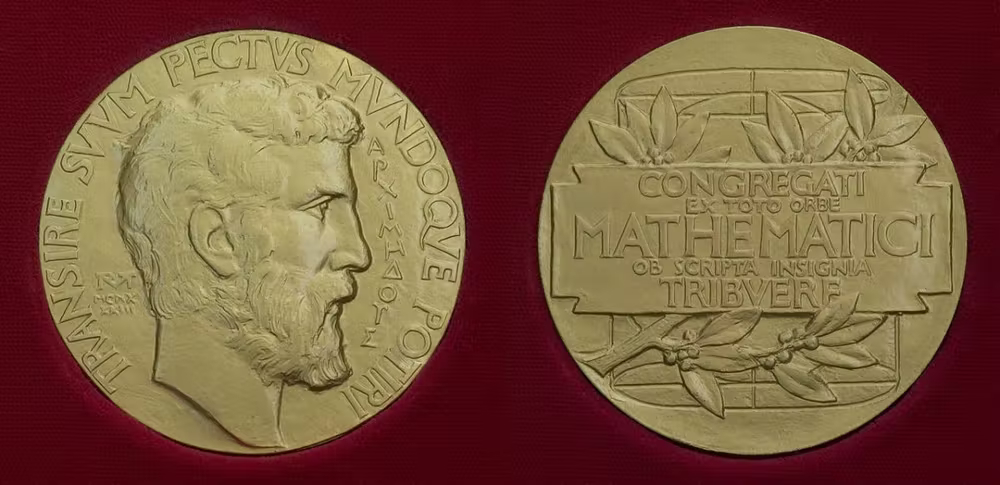
In a world often defined by headlines of conflict and politics, one woman from Iran quietly reshaped the narrative with the power of her mind. Her name was Maryam Mirzakhani, a mathematician who not only broke barriers but also changed the way we look at the universe of numbers. In 2014, she made history by becoming the first woman ever to win the Fields Medal, often called the 'Nobel Prize of mathematics.'
This is the story of a girl who once dreamed of becoming a writer and ended up scripting a new chapter for women in science.
From a Reluctant Student to a Math Champion
Born in Tehran, Iran, Maryam Mirzakhani's first love wasn't mathematics. In fact, she initially found the subject uninteresting. Her heart was set on becoming a writer, weaving stories with words. Little did she know, she would one day tell profound stories through the language of numbers and shapes.
A pivotal moment came when a teacher introduced her to the world of mathematical puzzles. It was then that she began to see mathematics differently not as a collection of rigid formulas, but as a creative and imaginative journey. For Mirzakhani, solving a complex problem was like uncovering the plot of an intricate novel.
Her newfound passion and exceptional talent quickly became evident. As a teenager, she made waves by winning two gold medals at the International Mathematical Olympiad, the world's most challenging competition for young mathematicians. In 1995, she achieved a perfect score, a feat that signaled the arrival of a brilliant mathematical mind.
The Nobel Prize of Mathematics
The Fields Medal is widely considered the most prestigious award in the world of mathematics. Awarded every four years to mathematicians under the age of 40, it recognizes outstanding mathematical achievement and the promise of future accomplishments. Before 2014, in its nearly 80-year history, the prize had never been awarded to a woman.
That all changed when Maryam Mirzakhani received the honor for her groundbreaking work on the dynamics and geometry of complex surfaces. Her research, which explored the symmetries of curved surfaces, had far-reaching implications, connecting different fields of mathematics and even theoretical physics. Her win was a monumental moment, shattering a long-standing barrier and inspiring a new generation of women in STEM.
A Unique Way of Thinking: Doodles and Daydreams
What set Mirzakhani apart was not just her intellect, but her unique approach to problem-solving. Her working style was highly visual and creative. Instead of filling notebooks with dense equations, she would spread large sheets of paper on the floor and doodle, sketching diagrams and drawings of surfaces and curves. Her daughter would often see these intricate drawings and say, "Mummy is painting again."
There’s more to life than simply increasing its speed.
By Udaipur Freelancer
For Mirzakhani, mathematics was a slow, deliberate process of exploration. She described it as being lost in a jungle, trying to find a path out by using all the knowledge she could gather. She was known for her patience and persistence, often thinking about a single problem for years, viewing it from different angles until a solution began to emerge. This slow and steady approach allowed her to tackle some of the most difficult questions in her field with fearless ambition.
A Life Beyond Numbers
Despite her international fame, Maryam Mirzakhani was a remarkably quiet and private person. She was married to Jan Vondrák, a Czech theoretical computer scientist, and they had a daughter named Anahita. After completing her undergraduate studies in Iran, she moved to the United States for her Ph.D. at Harvard University. She later became a professor at Stanford University, where she continued her pioneering research.
Mirzakhani’s life was a testament to her quiet determination and deep intellectual curiosity. She navigated different cultures and academic environments, all while remaining focused on the beautiful complexities of mathematics.
A Legacy That Endures
Tragically, just as her influence was growing, Mirzakhani was diagnosed with breast cancer. She continued her research with unwavering dedication, refusing to let her illness stifle her passion for discovery. In 2017, Maryam Mirzakhani passed away at the age of 40.
Her death was a profound loss for the mathematical community and the world. However, her legacy continues to shine brightly. She proved that someone who once disliked math could grow to become one of its greatest minds. Her life and work continue to inspire students, particularly young women, who may feel intimidated by mathematics.
Maryam Mirzakhani's story is a powerful reminder that the beauty of mathematics lies not just in finding the right answer, but in the creative and often winding path we take to get there. Through her quiet brilliance and relentless curiosity, she not only changed her field but also changed how the world sees the potential of women in science.
Udaipur Freelancer delivers high-quality web, marketing, and design solutions. We focus on building impactful digital experiences that help your brand succeed in today's market.


















Recommended for you
Must-See Art Exhibitions Around the World This Year
The Revival of Classical Art in a Digital Age
Breaking Down the Elements of a Masterpiece Painting
The Revival of Classical Art in a Digital Age