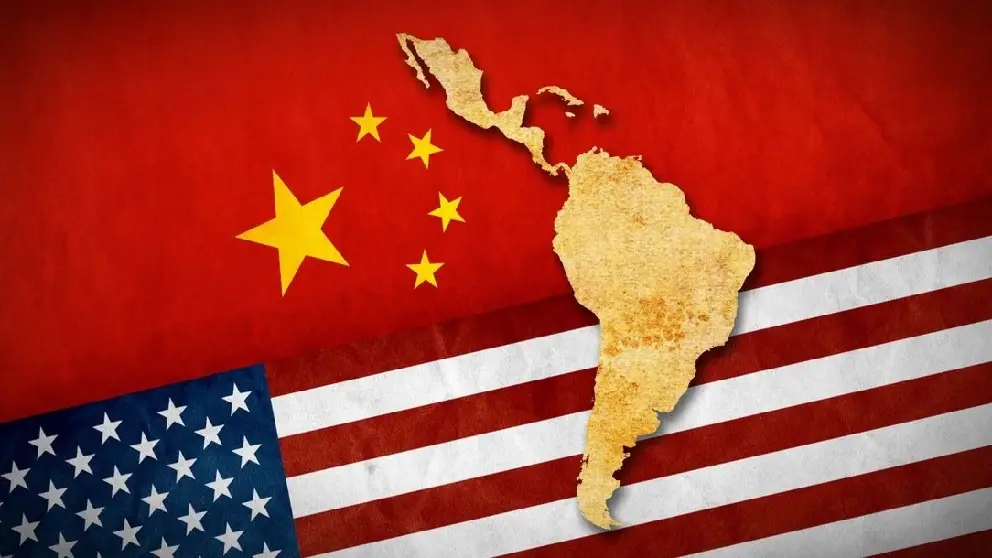
Hey everyone, welcome back to the blog! Today, we need to talk about something massive happening right in the geopolitical backyard of the United States. If you have been paying attention to global news, you know that the rivalry between the United States and China is the defining story of our time. But while a lot of people are looking at the South China Sea or tech wars over microchips, there is a quieter, incredibly strategic chess game happening much closer to home, Latin America.
Recently, a major US Congressional report sounded a loud alarm over how quickly and deeply China is expanding its footprint in Latin American countries. I was reading through this report, and honestly, the scale of what is happening is mind-blowing.
The document, which was released by the House Select Committee on the Strategic Competition between the United States and the Chinese Communist Party (CCP), is titled 'Pulling Latin America into China’s Orbit.' And that title really says it all. The report dives deep into the different ways Beijing is using money, technology, diplomacy, and even military ties to shift the balance of power in an area of the world that has traditionally been closely aligned with the United States.
Let’s break down exactly what this report found, why it matters, and how China is playing a very long, very smart game. I promise to keep this simple, casual, and easy to digest!
Building Up The Neighborhood: Economic Integration and The Belt & Road
To understand how China is gaining so much influence, you have to look at the money. At the absolute center of China’s strategy in Latin America is something called the Belt and Road Initiative (often just called the BRI).
Think of the BRI as the biggest, most ambitious global construction project in history. Through this initiative, Beijing has successfully convinced dozens of Latin American and Caribbean nations to sign on. What does this mean in real life? It means that Chinese state-owned companies and businesses connected to the Chinese government are financing and building massive infrastructure projects.
We are talking about deep-water ports where massive cargo ships dock, huge highways that cut across countries, thousands of miles of railways, and modern energy grids. On the surface, this sounds great, right? Developing countries desperately need good roads and reliable power. However, the Congressional report highlights a major catch.
While these projects do fix real infrastructure problems for these developing nations, they come with long-term strings attached that have US officials sweating. For example, let’s look at the maritime ports. The report points out that companies linked to the People's Republic of China (PRC) now hold ownership stakes in, or directly operate, dozens of port facilities all across Latin America.
Some of these ports are located near incredibly important global trade routes, like the Panama Canal. The worry here is what experts call dual-use capabilities. Right now, these ports might be used for civilian cargo ships bringing in electronics and taking out soybeans. But because China controls the logistics, there is a very real potential that these facilities could be used by the Chinese military in the future. It gives Beijing a massive logistical advantage right near US borders.
Furthermore, it is not just about building things. it is about buying things. Over the last twenty years, trade between China and Latin America has skyrocketed. Today, China is actually the number one largest trading partner for several major South American nations, including heavyweights like Brazil, Chile, and Peru. When your economy relies that heavily on one country buying your goods, that country gets a lot of leverage. The report warns that this economic dependency allows Beijing to apply intense political pressure on these nations whenever China’s core interests are threatened.
The New Gold Rush: The Race for Critical Minerals
Okay, let's shift gears from highways and ports to what is under the ground. A huge portion of this Congressional report focuses on resource extraction. If you want to know who is going to win the future of technology, look at who controls the raw materials.
Latin America happens to be home to massive reserves of critical minerals. These are the elements that are absolutely essential for modern technology and the global shift toward green energy. We are talking about copper, rare earth elements, and, most importantly, lithium.
Have you heard of the Lithium Triangle? It is a region that covers parts of Argentina, Bolivia, and Chile. Believe it or not, this one area contains more than half of the entire world’s known lithium reserves. If you have a smartphone in your pocket, a laptop on your desk, or if you drive an electric vehicle (EV), you rely on lithium batteries.
According to the Select Committee, Chinese corporations have not been sitting on the sidelines. They have aggressively moved in to completely dominate the supply chains for these precious minerals. Beijing is buying up stakes in major mining operations and locking down long-term purchasing agreements.
Why are they doing this? To make sure that China has an endless, steady flow of the materials it needs for its own factories back home. China wants to be the absolute king of manufacturing electric vehicle batteries, solar panels, and advanced electronics.
The Congressional report throws up a massive red flag here. It cautions that this dominance does more than just make China rich and technologically advanced. It also creates a massive risk for the United States and its allies. If China controls all the lithium and copper, they can squeeze the US out, making it incredibly difficult for America to build its own green energy technologies and maintain its defense industry. In short, whoever controls the minerals controls the future.
Digital Dominance: Technological Expansion and Surveillance
This is where things start to sound like a sci-fi movie, but it is happening right now. Beyond physical things like bridges and raw minerals, the report sheds a lot of light on China’s expanding technological presence in the region.
The export of digital infrastructure is a massive piece of Beijing’s puzzle. Big Chinese telecommunications giants you have probably heard of Huawei and ZTE have managed to grab massive shares of the market in Latin America. They are the ones building out the brand new 4G and ultra-fast 5G networks. They are building massive data centers and setting up cloud computing facilities for these countries.
Now, why does the US care who builds a cell tower in Latin America? The Select Committee has deep concerns about the security vulnerabilities that come with widespread adoption of Chinese-developed tech. For years, US policymakers have warned that if Chinese companies build the telecom equipment, that equipment could secretly be used to gather intelligence. Imagine if all the phone calls, text messages, and internet traffic of a country are flowing through routers controlled by a foreign power. During a crisis, there are fears this tech could even be leveraged to shut down or disrupt critical networks.
But it goes deeper than just internet speeds. The document highlights the spread of Chinese smart city and safe city technologies across Latin America. These systems are marketed to local governments as amazing tools for fighting high crime rates. And how do they work? They usually involve installing thousands upon thousands of high-tech surveillance cameras, all equipped with advanced facial recognition software.
Local politicians love it because it sounds like a tough-on-crime solution. However, the committee's report notes a much darker side. By installing these systems, China is essentially exporting a model of pure digital surveillance. The fear is that this technology empowers illiberal regimes, gives governments too much power to watch their citizens, and ultimately undermines democratic institutions and basic privacy rights in the region. It is handing over the ultimate spying toolkit.
There’s more to life than simply increasing its speed.
By Udaipur Freelancer
The Diplomatic Chessboard: Soft Power and Isolating Taiwan
Of course, power isn't just about money and technology, it is about friends, alliances, and voting blocs on the world stage. Diplomatically, the report outlines how China has run a very systematic and aggressive campaign to isolate Taiwan.
As you may know, China claims Taiwan as its own territory, while Taiwan operates as an independent democracy. For a long time, several Latin American countries officially recognized Taiwan instead of Beijing. China has been working hard to flip that.
They do this by enticing Latin American nations to switch their official diplomatic recognition from Taipei to Beijing. And it has been working. In recent years, several countries in Central America and the Caribbean have severed their historical ties with Taiwan. This list includes Panama, El Salvador, the Dominican Republic, Nicaragua, and Honduras.
How does China convince them to flip? The committee argues that these diplomatic changes do not happen out of the goodness of their hearts. They are almost always accompanied by massive promises. Beijing will offer lucrative investment deals, highly favorable loans, and broader access to the massive Chinese trade market. It is highly transactional. It is basically saying, Drop Taiwan, and we will build you a new stadium and a new port.
The report also mentions how China is growing its influence inside regional organizations. For example, they are trying to leverage their position in entities like the Inter-American Development Bank (IDB). They use this influence to steer lucrative contracts toward Chinese firms, even though China only holds a tiny percentage of shares in the actual bank.
Add to this the expansion of soft power. China is pushing hard on academic exchanges, partnering with local media outlets, and opening cultural institutes. All of this is designed to shape a friendly, favorable narrative about China’s rise among the regular people of Latin America. They want the public to see China as a generous friend, not a threat.
Boots on the Ground: Security and Military Implications
While money, phones, and trade deals form the foundation of China’s presence, we cannot ignore the military side of things. The Select Committee report details how security and military linkages between Beijing and Latin America are growing steadily.
China is actively increasing its military-to-military diplomacy. What does this look like? It means bringing Latin American military officers over to China for training programs and professional military education. It is about building relationships with the next generation of generals in these countries.
Furthermore, sales of Chinese military equipment have been ticking upward over the last ten years. We are talking about everything from transport aircraft and armored vehicles to basic small arms and rifles.
But here is the detail that is particularly concerning to the US committee. the establishment of space and satellite tracking facilities in the region. The report highlights a very specific deep space tracking station located in Neuquén, Argentina.
Here is the kicker, this station in Argentina is actually operated by the Chinese military. Just like the ports, space facilities have a dual-use nature. Yes, they can be used for peaceful space exploration. But the US is highly concerned that this facility could easily be used for intelligence gathering or to monitor and spy on US and allied space assets and satellites. Having a Chinese military-run space tracking station in the same hemisphere as the US is a major red flag for Washington.
The Bottom Line: A Call for Competitive Alternatives
So, after laying out all these terrifying facts, what is the conclusion? The report, "Pulling Latin America into China's Orbit," makes it crystal clear that the Chinese Communist Party's advancements in the Western Hemisphere are a direct, immediate challenge to US national security and economic prosperity.
But the committee also makes a very important point. Washington cannot just walk into these countries, bang their fists on the table, and demand that their southern neighbors cut ties with China. You can't tell a developing country to stop talking to their largest economic partner unless you have something better to offer them. Right now, China is offering cash, roads, and 5G.
Instead of just complaining, the Select Committee is advocating for the US to wake up and create a proactive, comprehensive strategy. The US needs to offer realistic, competitive alternatives to Chinese investment.
The document is essentially a massive wake-up call for the United States to reinvigorate its relationship with Latin America. It calls for expanded, better trade agreements. It calls for the US to step up and provide increased development finance so these countries don't have to go to Chinese banks for loans. It calls for deeper, more respectful partnerships.
Ultimately, this congressional warning serves to say one thing, countering China’s massive gravitational pull in Latin America is going to take a lot of work. It will require sustained attention, actual financial resources, and a strategic vision that treats Latin America not as an afterthought, but as a region critically important to the future of global stability.
What do you guys think?
Are you surprised by how deeply China is involved in Latin America, from lithium mines to military space stations? Do you think the US is doing enough to maintain its relationships with its southern neighbors, or has Washington dropped the ball? Let me know your thoughts in the comments below! I read every single one.
If you found this breakdown helpful, be sure to share this post and subscribe for more deep dives into the global stories that actually matter!












Recommended for you
Must-See Art Exhibitions Around the World This Year
The Revival of Classical Art in a Digital Age
Breaking Down the Elements of a Masterpiece Painting
The Revival of Classical Art in a Digital Age