Hey everyone!
If you're a mutual fund investor like me, you know that while the returns can be great, the tax rules can sometimes feel a bit complicated and, let's be honest, a little painful. Well, some good news might be on the horizon!
With the Union Budget 2026 approaching, the Association of Mutual Funds in India (AMFI) has been busy. They've sent a list of six major suggestions to the Finance Ministry. The goal? To make investing in mutual funds easier, more attractive, and more rewarding for middle-class families and long-term investors.
These are just proposals for now, but if the government gives them the green light, it could mean more money in our pockets. So, let's break down these six big ideas in simple terms and see what they could mean for you.
1. Bringing Back a Tax-Saving Superpower for Debt Funds
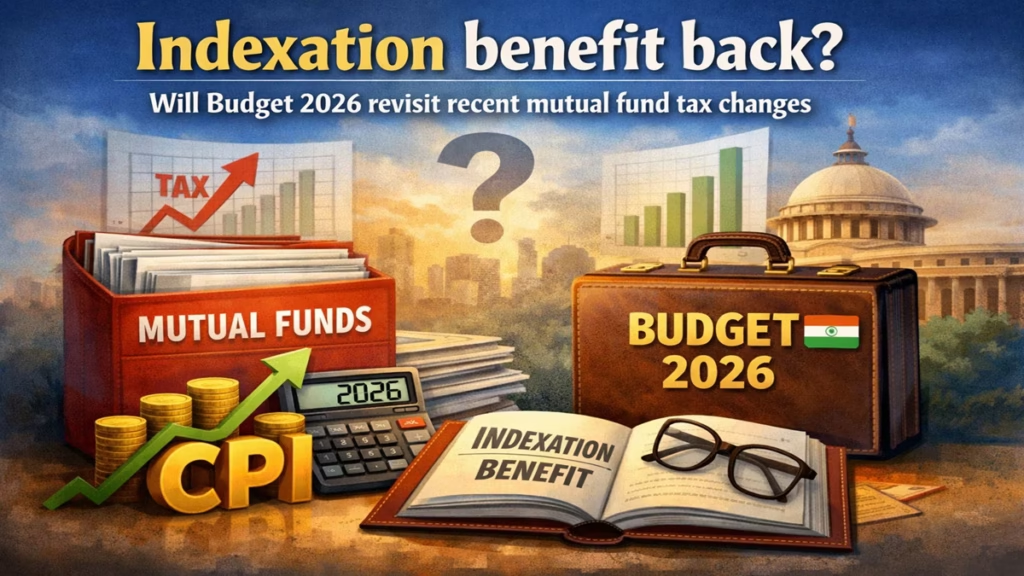
Remember indexation? It was a fantastic benefit for debt mutual fund investors. In simple words, it helped reduce your tax by accounting for inflation. This meant you paid tax only on the real profit you made, not the profit that was just due to rising prices.
This benefit was taken away recently, making debt funds less attractive.
The Proposal: AMFI has asked the government to bring back this indexation benefit for debt funds that you hold for more than three years.
What it means for you: If this comes back, your long-term investments in debt funds will become much more tax-friendly, leaving you with higher returns after tax.
2. Meet DLSS: The New Tax-Saver on the Block?
We all know and love ELSS (Equity Linked Savings Scheme) for saving tax under Section 80C. But ELSS invests in the stock market, which can be risky for some people.
The Proposal: AMFI has suggested creating a brand new category called DLSS (Debt Linked Savings Scheme). This would be a tax-saving scheme that invests mostly in safer debt instruments. It would have a lock-in period of 3-5 years and, importantly, its own separate tax deduction limit.
What it means for you: This would be a fantastic option for conservative investors who want to save tax without taking on stock market risk. It would be a new, safe way to reduce your tax bill.
3. Making the Popular ELSS Fit for the New Tax System
The government introduced a New Tax Regime a few years ago, which offers lower tax rates but removes most deductions. A major downside is that you can't claim the tax benefit for ELSS investments if you choose the new system.
The Proposal: AMFI has two smart suggestions here. First, allow the ELSS tax deduction even under the New Tax Regime. Second, remove the old rule that you have to invest in ELSS in multiples of ₹500.
What it means for you: This would give you the freedom to choose the New Tax Regime without losing out on the popular ELSS tax-saving benefit. It makes tax planning much more flexible!
4. A Bigger Tax Break on Your Long-Term Gains
Currently, when you sell your stocks or equity mutual funds after one year, any profit (Long Term Capital Gain) above ₹1 lakh is taxed. While it's great that the first lakh is tax-free, that limit has been the same for a while.
There’s more to life than simply increasing its speed.
By Udaipur Freelancer
The Proposal: AMFI believes this ₹1 lakh tax-free limit is too low and has asked the government to increase it.
What it means for you: A higher limit means more of your profits would be tax-free! This would be a direct boost to your in-hand returns from long-term equity investments.
5. Fairer Taxes for Fund of Funds
A Fund of Funds (FoF) is a mutual fund that invests in other mutual funds. Here's the quirky part. even if an FoF invests entirely in equity funds, it's currently taxed like a debt fund, which is less favourable. It just doesn’t seem fair.
The Proposal: AMFI is asking for a simple, logical change. tax a Fund of Funds based on what it invests in. If it invests in equity funds, tax it like an equity fund.
What it means for you: This would fix a strange rule and could make Fund of Funds a more attractive and straightforward investment option.
6. Making Mutual Funds a Better Choice for Your Retirement
When it comes to retirement planning, the National Pension System (NPS) gets some special tax advantages that mutual fund retirement schemes don't. This creates an uneven playing field.
The Proposal: AMFI has suggested that mutual fund retirement schemes should get the same tax benefits as the NPS.
What it means for you: This would give you more competitive and flexible options for your retirement planning. You could choose a mutual fund retirement plan knowing it has the same tax advantages as other popular options.
Final Thoughts
These six proposals from AMFI are practical, investor-friendly, and could genuinely encourage more people to save and invest for the long term. They aim to simplify taxes, provide more choices, and ultimately, help us build wealth.
Of course, these are just recommendations for now. We’ll have to wait for the Union Budget 2026 to see which of these ideas Finance Minister Nirmala Sitharaman accepts.
But let's keep our fingers crossed! If even a few of these changes are implemented, it could be a big win for the entire mutual fund community.
What do you think about these proposals? Which one are you most excited about? Let me know in the comments below


















Recommended for you
Must-See Art Exhibitions Around the World This Year
The Revival of Classical Art in a Digital Age
Breaking Down the Elements of a Masterpiece Painting
The Revival of Classical Art in a Digital Age