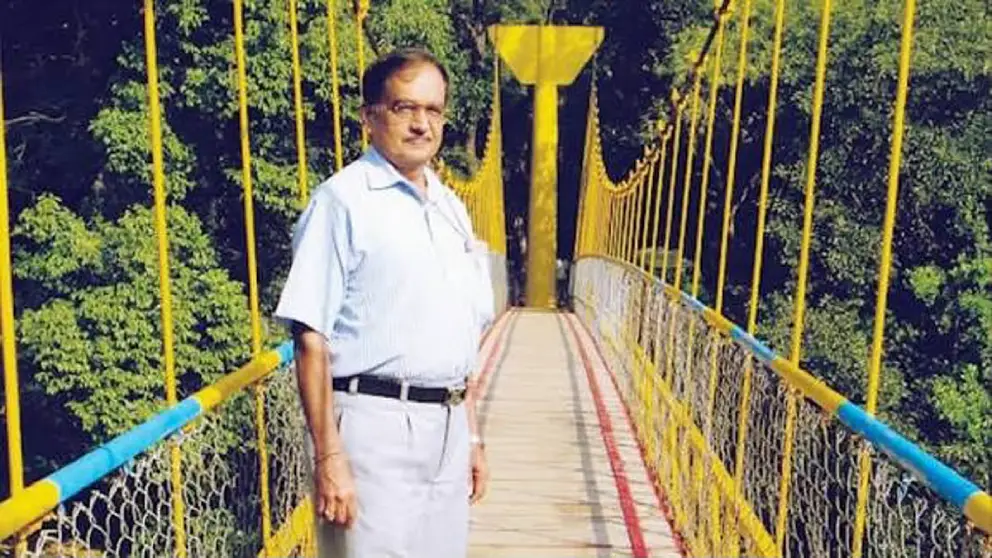
India has lost one of its greatest silent heroes. Girish Bharadwaj, who was lovingly called the 'Bridge Man of India,' passed away on Tuesday in Karnataka. He was 76 years old. He had been admitted to a private hospital in Sullia, located in the Dakshina Kannada district, because of a heart condition. Sadly, he breathed his last there. His death marks the end of an era of simple, life-saving engineering that helped the poorest people in rural India.
Girish Bharadwaj was not an ordinary engineer. He was a Padma Shri awardee who dedicated his whole life to helping people in remote villages. He built over 300 low-cost hanging bridges across the country. These bridges connected isolated villages to the main world. Before his bridges, people in these villages had no safe way to cross rivers or canals. They had to swim through dangerous waters or use risky boats just to get to school, work, or hospitals.
Girish completed his degree in mechanical engineering in the year 1973. While many of his classmates wanted to move to big cities or go abroad, Girish chose a different path. While some dream of traveling to European countries and wonder what kind of visa do you need to visit Switzerland, Girish decided to stay in the rural parts of India. He wanted to use his skills to solve real, everyday problems faced by ordinary villagers.
After graduating, he set up a small workshop in Sullia. At first, he did regular metal work. But his mind was always looking for ways to help his community. He lived in the Dakshina Kannada district, which gets very heavy rainfall every year. During the monsoon season, small streams and rivers would swell up. This cut off entire villages from the rest of the world. Villagers had to risk their lives daily just to buy food or get medical help.
A Lifeline for Rural Children and Villagers
The lack of proper roads and bridges had a terrible impact on the local people, especially children. During the rainy season, children could not cross the swollen rivers to reach their schools safely. Because of this, many children had to drop out of school. Seeing this sad situation, Girish Bharadwaj decided to take action. He knew he had to find a solution that was safe, strong, and most importantly, very cheap.
In 1989, Girish built his very first hanging footbridge. This bridge was built over the Payaswini River at Aramburu in Sullia. It was a simple, budget-friendly structure. This first bridge was a huge success. It showed the world that you do not need millions of rupees to build a safe crossing. This modest project defined the rest of his life and career.
The Philosophy of Low-Cost Engineering
What made Girish Bharadwaj's work so special was his focus on low-cost solutions. Traditional concrete bridges take years to build and cost a lot of money. Remote villages often had to wait for decades for government projects to reach them. Girish changed this. He designed suspension bridges that could be built quickly using local labor and materials. This not only saved money but also gave local villagers a sense of pride as they helped build their own bridges.
He believed that technology should serve the poorest first. His suspension bridges used steel ropes and wooden or steel planks. They were light but strong enough to carry people, bicycles, and sometimes even small two-wheelers. By keeping the design simple, he ensured that the bridges were easy to maintain by the villagers themselves. This sustainable approach is a great lesson for modern builders today.
There’s more to life than simply increasing its speed.
By Udaipur Freelancer
Over 300 Bridges of Hope
After his first bridge, there was no looking back for Girish. Over the next few decades, he built more than 300 hanging bridges. His work spread from Karnataka to other states like Kerala, Andhra Pradesh, and Odisha. He became a savior for hundreds of isolated communities. He designed suspension footbridges that were perfect for difficult and hilly terrains. These bridges offered a simple and practical way for people to travel safely.
His low-cost designs were so successful that even the Indian government noticed them. Soon, the government began to use his unique suspension bridge designs to build hanging bridges in other remote parts of the country. Today, as India discusses modern transport policies like the budget 2026 EV price drop in India to boost clean travel, we must remember that simple footbridges were the first step to progress for millions of rural Indians.
Awards and Recognition for a True Hero
Girish Bharadwaj’s selfless work did not go unnoticed. In 2017, the Government of India honored him with the Padma Shri, which is the nation's fourth-highest civilian award. He also received honorary doctorates from respected institutions, including the University of Mysuru. His amazing life story has also inspired filmmakers. Director Santhosh Kodenkeri recently announced a biopic on his life titled 'Sethu Bandhu', which means the bridge builder.
Girish Bharadwaj showed us that true engineering is not just about building giant structures in big cities. It is about solving real human problems with simple, smart, and caring solutions. He brought isolated people into the mainstream of Indian society. His life teaches us that one person can build bridges of hope and change the lives of thousands.
We offer our deepest condolences to his family and friends. The bridges he built will stand for many years as a tribute to his beautiful mind and kind heart. Rest in peace, Bridge Man of India.













Recommended for you
Must-See Art Exhibitions Around the World This Year
The Revival of Classical Art in a Digital Age
Breaking Down the Elements of a Masterpiece Painting
The Revival of Classical Art in a Digital Age