When we think of Delhi’s history, our minds usually jump to the grand monuments of the Mughals or the bustling streets of the Sultanate era places like Mehrauli, Siri, Tughlaqabad, and Shahjahanabad. But what if We told you that long before all of that, a completely different dynasty was shaping the landscape of this city?
Hidden away on the southernmost edge of Delhi, deep within the rugged Aravalli hills, lies a massive, 1,100-year-old structure that most people don't even know exists. It is the Anangpur Dam, built by the Tomar dynasty. Let me take you on a journey to uncover this hidden chapter of Delhi’s early medieval past.
The Bumpy Ride into the Past
Finding this place is an adventure in itself. Just about 5 kilometers away from the popular ancient Surajkund reservoir, the road quickly changes. If you are riding a motorcycle, the journey turns into a tricky passage through broken ground and dirt tracks.
The roads narrow down, the terrain becomes harsh, and the undulating, rocky ridges of the Aravalli hills slowly swallow you up. This is the exact spot where the last rocky outcrops fade into Haryana's ancient landscape. Finally, perched right at the southern entrance of Delhi, you arrive at the Anangpur Dam.
The moment you step onto the site, the vibe completely changes. You realize you aren't just looking at some old ruins, you are standing in front of a brilliant piece of ancient hydraulic engineering.
A Broken Signboard and a Fading Memory
Unfortunately, the first thing that greets you at the dam is a bit heartbreaking. At the entrance, there is an information plaque set up by the Archaeological Survey of India (ASI). But it is damaged.
Mysteriously, the specific parts of the text mentioning the Tomars have been deliberately scratched out. According to the locals, this wasn't an accident. Some say it was an intentional act driven by local caste, social, or political tensions. Whether it was done out of neglect or vandalism, it feels like someone is trying to erase the historical record before you even get to see the monument.
The Ultimate Engineering Marvel
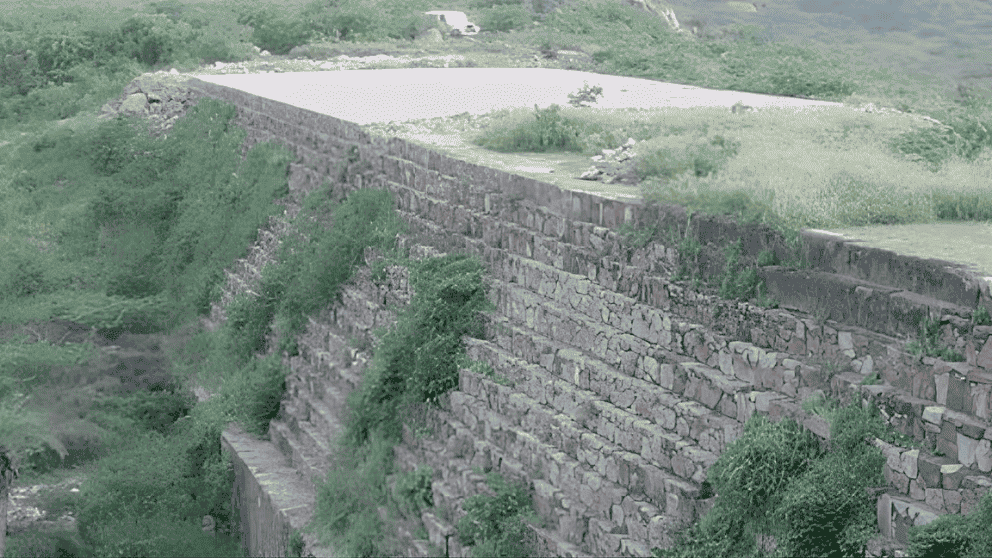
Once you walk past the damaged sign, the massive dam wall comes into view. And wow, is it impressive! It doesn't look like a standard water barrier, it looks more like a fortified wall squeezed between two low hillocks.
Let’s talk about some numbers to give you an idea of its size:
Length: About 101 meters long.
Height: Rises over 10 meters from the base.
Width: It’s about 19.8 meters wide at the top and heavily broadens to 27.4 meters at the bottom to handle the immense pressure of the water.
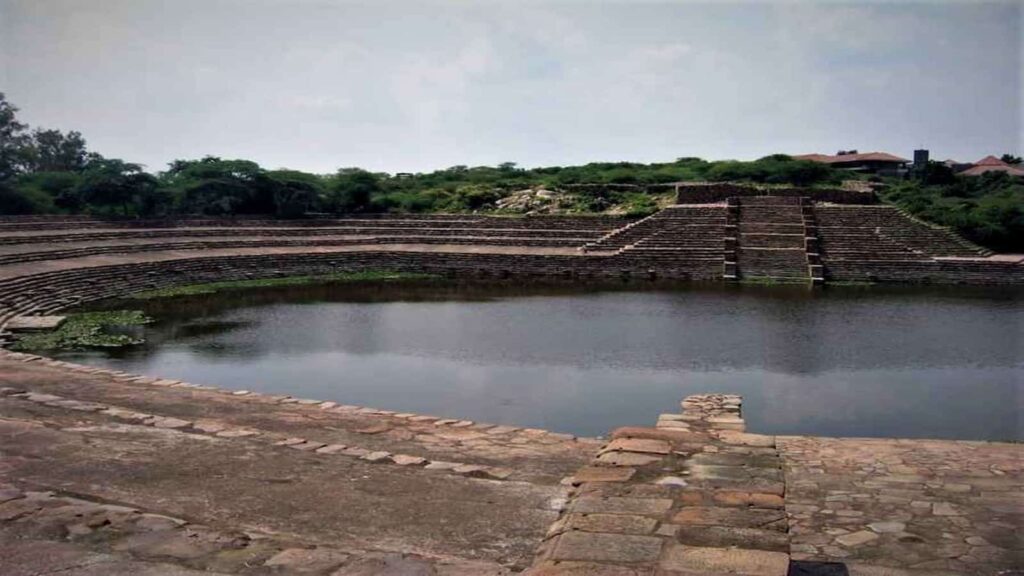
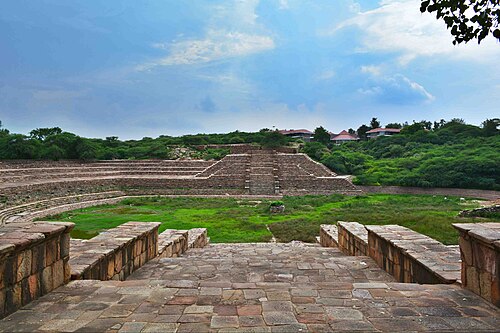
Built using huge stone-masonry blocks held together with brick and earth, this dam was designed perfectly for its rocky environment. The builders used the natural slope of the Aravalli hills (which rise to about 100 meters here) to catch rainwater and funnel it into a basin.
Along the wall, there are at least 7 water-release passages. These have grooved, cat-like channels that acted as regulating gates to control the flow of water down towards the Surajkund reservoir. Anangpal II is credited with laying the foundation for this amazing structure!
Who Were the Tomars?
You can't talk about this dam without talking about the Tomar kings. These rulers transformed this wild frontier into a stronghold and ruled over the region for nearly 419 years, with a succession of 20 different rulers.
Their history is a mix of hard facts, memory, and myth:
There’s more to life than simply increasing its speed.
By Udaipur Freelancer
A British historian named James Tod linked the Tomars to the legendary Pandavas, connecting them to the ancient city of Indraprastha (from the Mahabharata).
Other writers like Matthew Atmore linked them to the legendary lineages of Vikramaditya.
Archaeologist Alexander Cunningham connected the Tomars to the founding of Lal Kot (around the 11th century CE).
The Tomars held their ground for four centuries during a crazy time in Indian history, surviving the massive political struggles between the Gurjara-Pratiharas, Palas, and Rashtrakutas. Eventually, in the 12th century, they lost control to the Chauhans as their power expanded across North India. Interestingly, some historians believe this transition wasn't a bloody war, but rather a peaceful dynasty alliance through marriage between the Chauhans and the family of the last Tomar ruler, Anangpal III.
Anangpur: A Village Older Than the City
Archaeological evidence shows that organized settlements in this region began around the 4th century CE. But it goes back even further stone tools found here suggest humans lived in this exact spot as early as 10,000 BC!
The local village, Anangpur, is central to this whole story. Locals say the settlement has been around since at least 800 AD, making it one of the oldest in Delhi.
A local resident, Rahul Bhadana, shared some amazing memories. He said that when he was younger, the dam held water almost all year round. The water levels were so good that leopards were a common sight (and they never harmed the villagers!). He also mentioned local legends that the dam originally had wooden gates, which were later replaced with stone during the Sultanate period. The village even used to have a beautiful ancient Torana (a gateway) that served as an entrance marker, though the ASI has since moved it.
Believe it or not, the biodiversity here was so beautiful that Jawaharlal Nehru himself visited the village in 1959 and was highly impressed by the landscape and the local community!
The Modern Threat: Heritage Under Pressure
Sadly, the end of this story isn't as beautiful as its beginning. Today, this incredible ancient water system is under massive threat.
The Aravalli region is currently facing relentless pressure from illegal construction, land conversion, and ecological damage. When reporters visited recently, they saw bulldozers actively leveling the land and clearing vegetation. Even worse, the main dam site felt less like a protected heritage spot and more like an illegal private party venue. There were expensive cars parked right next to the ruins, playing loud music in an ecologically sensitive zone. When the locals saw cameras, they got uneasy and confrontational.
Why is this happening? Because of money. Local revenue records show that land values in this 12-kilometer stretch of the Aravallis have skyrocketed, touching an estimated Rs 1,000 crore. This massive economic pressure makes the Anangpur dam more vulnerable today than it has been in 1,100 years.
Why We Need to Care
The Tomars didn't just rule with stone walls and forts, they ruled with water intelligence. They built a linked system of stepwells, tanks, and dams (much like the famous Rani ki Vav or Chand Baori) to survive in a difficult climate.
Today, experts are constantly warning us about urban water crises and scary Day Zero scenarios where cities run completely out of water. Yet, we are letting an ancient, brilliant water-recharge system get buried under concrete, scrub, and neglect.
The Anangpur Dam isn't just a pile of old rocks. It is a memory of the Tomars. It is a fragment of the Delhi that existed before Delhi became the city we know. Most importantly, it is a warning: if we lose these sites to bulldozers and real estate, we aren't just losing our heritage we are losing the ancient knowledge systems that once made survival in this landscape possible.
Udaipur Freelancer delivers high-quality web, marketing, and design solutions. We focus on building impactful digital experiences that help your brand succeed in today's market.















Recommended for you
Must-See Art Exhibitions Around the World This Year
The Revival of Classical Art in a Digital Age
Breaking Down the Elements of a Masterpiece Painting
The Revival of Classical Art in a Digital Age