Hey everyone, and welcome back to the blog! Today, I want to take you on a virtual journey to a place that feels completely out of this world. Have you ever wondered what it feels like to drive to the absolute edge of a country? I’m not just talking about crossing a border into another land, I’m talking about driving to a point where the solid ground beneath you finally gives up, and there is nothing but endless, deep blue ocean stretching out right in front of your eyes.
India is a massive country with mountains, deserts, and huge forests. But down in the deep south, there is a specific stretch of road that offers an experience unlike anywhere else. It is an amazing mix of geography, ancient legends, and a history that will give you goosebumps. Traveling to the nation’s edge offers sweeping ocean views and a powerful sense of standing at the end of the world.
Grab a cup of coffee, get comfortable, and let’s dive into the fascinating story of the Last Road of India.
Where Exactly is the Last Road?
If you look at a map of India and trace your finger all the way down to the bottom right, you will find the beautiful state of Tamil Nadu. Inside the Ramanathapuram district lies a famous holy town called Rameswaram.
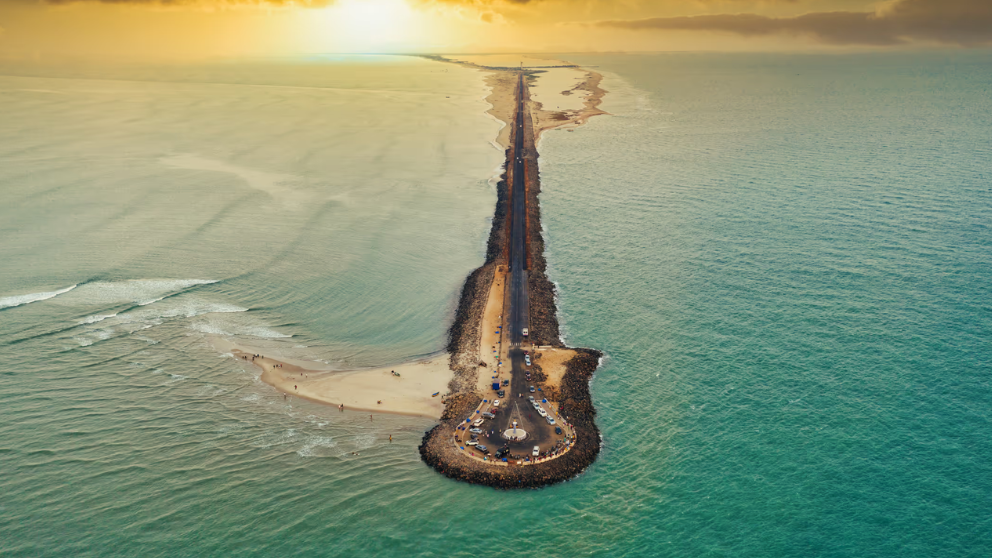
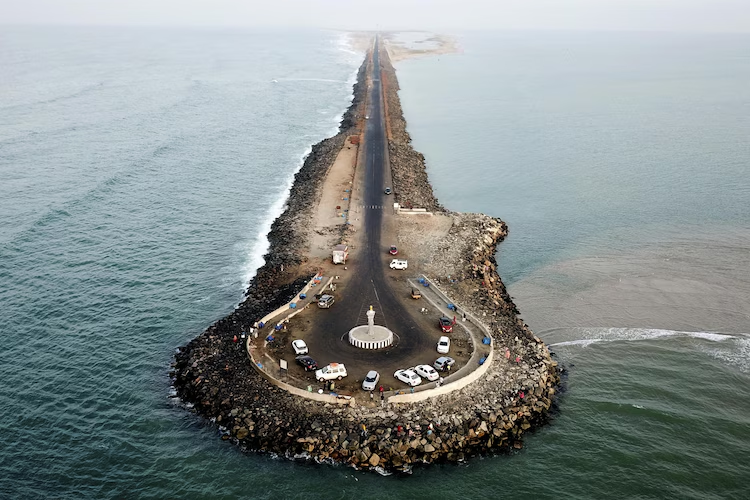
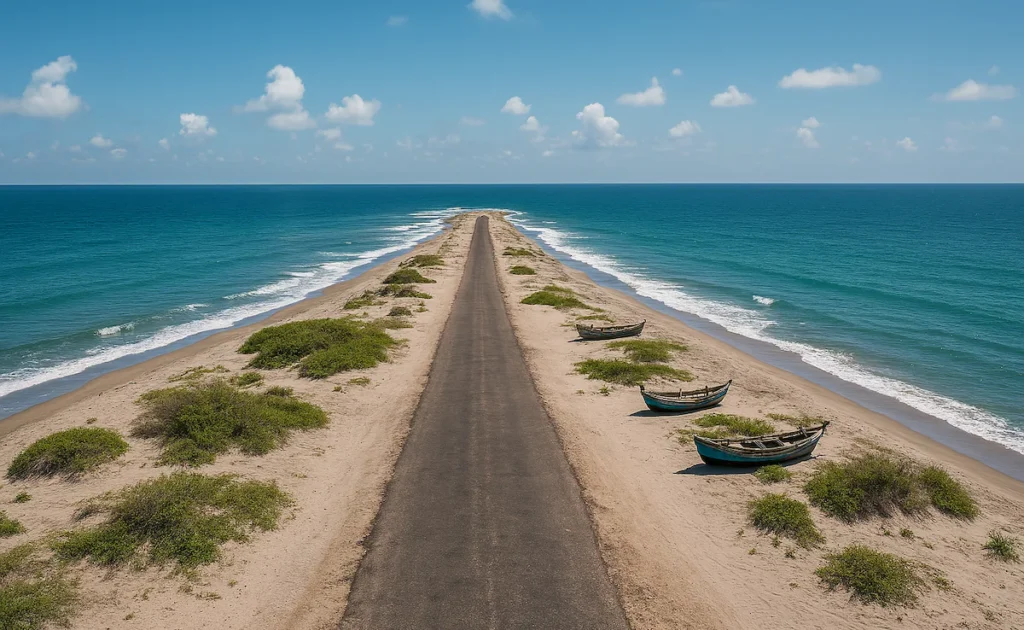
The last road we are talking about is actually the final part of National Highway 87 (NH87). The journey starts from the town of Rameswaram and takes you all the way to a place called Arichal Munai, which is located in Dhanushkodi. This specific spot marks the absolute farthest motorable edge of the Indian mainland before the sea totally takes over. Literally, this is where the road ends and the vast sea begins.
The drive from Rameswaram to Dhanushkodi is roughly 20 kilometers. After that, a few extra kilometers of a barren, sandy track take you to Arichal Munai, which is the final frontier. It is a drive you will never forget.
A Drive Like No Other: Water on Both Sides!
What makes this coastal route so crazy and unique? It is the fact that it acts as a very narrow border between two massive bodies of water. As you drive down this stretch, you have the calm waters of the Bay of Bengal on one side of your window, and the rough, crashing waves of the Indian Ocean on the other side.
Imagine driving down a narrow strip of black road. You look to your left ocean. You look to your right ocean. It creates a completely surreal atmosphere. The endless horizons, the powerful and salty ocean winds hitting your face, and the sweeping blue waters make you feel like you are floating on water instead of driving on land. It is simply beautiful.
Stepping Back in Time: The Legend of the Ramayana
This amazing endpoint isn’t just about pretty views, it is deeply rooted in Indian mythology and history. If you are a fan of history or old legends, this place will blow your mind.
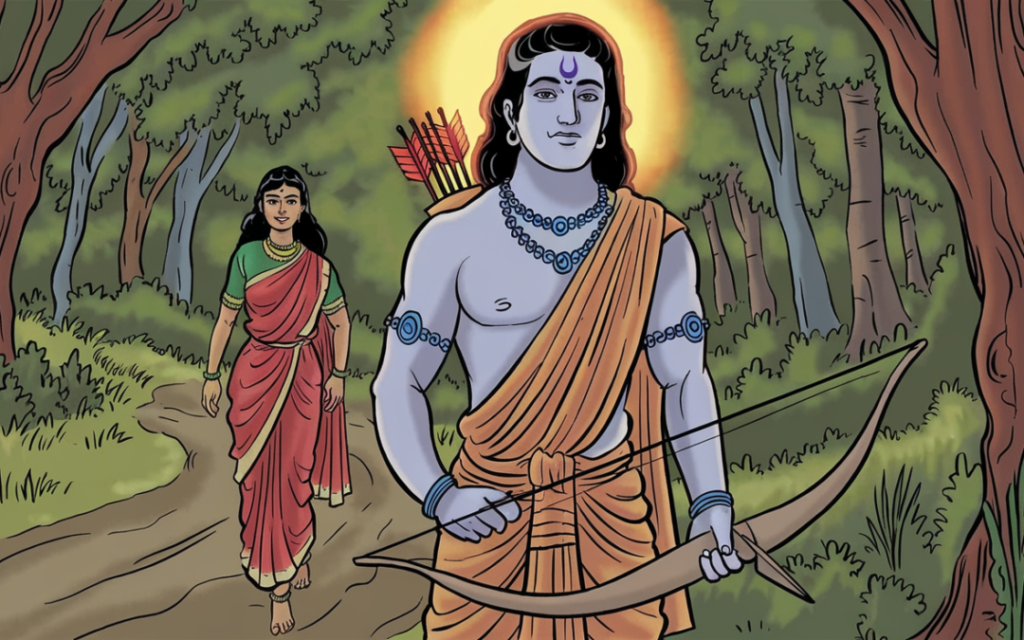
According to the ancient and holy epic, the Ramayana, this exact coastal stretch is believed to be the starting point of the legendary bridge built by Lord Ram. The bridge was built so he and his army could reach Sri Lanka. Today, there is a chain of limestone shoals hidden under the water, which is popularly known as Ram Setu, or Adam’s Bridge.
Even the name of the town has a cool story. Dhanushkodi translates to end of the bow. This name is symbolically linked to the popular belief that Lord Ram marked this exact spot with the tip of his famous bow before the great bridge was constructed. It is amazing to stand there and think about the ancient stories that happened right where your feet are planted.
The Ghost Town of Dhanushkodi: A Tragic History
Beyond the beautiful myths, Dhanushkodi holds a very tragic and spooky place in modern history. If you visited this place before 1964, you wouldn't see an empty beach. You would see a bustling, busy coastal town. It had everything houses, functioning schools, a working railway station, a busy port, and lively marketplaces filled with people.
However, everything changed in December 1964. A catastrophic cyclone struck the coast with terrifying power. It completely flattened the town and claimed many, many lives. The destruction was so massive and severe that the government officially declared the area unfit for habitation.
There’s more to life than simply increasing its speed.
By Udaipur Freelancer
Today, it remains a ghost town. When you visit, you can still see the haunting ruins of the old church, the railway station, and broken homes sitting in the sand. They silently narrate the sad past of a town that was swallowed by the sea. It adds a very deep, emotional layer to your road trip.
Why Is This Road So Special?
If you are wondering why you should add this to your travel bucket list, here is a quick summary of what makes it so amazing:
The Surreal Ocean Experience: As you drive along the narrow stretch, the sea appears on both sides of the road. It gives you an uninterrupted view reaching all the way to the horizon. It literally feels like you are driving into the ocean.
The Geographical End Point: Arichal Munai stands proudly as one of the last motorable points on the Indian mainland. It marks the exact place where the country’s landmass finally gives way to the vast, open waters.
The Scenic Coastal Drive: With its dramatic seascapes, windswept sands, and endless blue surroundings all around you, this route is regarded as one of the most striking, unique, and picture-perfect coastal drives in all of India.
Frequently Asked Questions About the Last Road
Because this place is so unique, people always have a lot of questions about it. Here are some quick facts to satisfy your curiosity:
1. Is this actually the last road in India geographically? Yes! In terms of the final point where a public motorable road on the Indian mainland ends before the sea begins, the stretch culminating at Arichal Munai in Dhanushkodi is widely recognized as the last road of India.
2. Can you drive your car beyond Arichal Munai? No, you cannot. The road completely concludes at Arichal Munai. Beyond that point lies the open sea, and moving any vehicles past this final point is simply not permitted (and physically impossible!).
3. How close is Sri Lanka from this last road? It is surprisingly close! Sri Lanka is only about 18 to 20 kilometers away across the sea from the tip of Dhanushkodi. On a very clear day, some locals say you can almost sense the neighboring country.
4. Does anyone still live in Dhanushkodi today? Not as a functioning town. As I mentioned earlier, Dhanushkodi was destroyed in the 1964 cyclone. Today, it remains largely abandoned, mostly home to the wind, the waves, and a few local fishermen.
A Road That Truly Touches the Edge
To wrap things up, the Last Road of India isn't just another highway marker or a regular road trip destination. It is a very special place where history, myth, and geography come together in perfect harmony.
From the ancient legends of the Ramayana to the silent, haunting ruins of Dhanushkodi, and finally to the endless, beautiful horizon at Arichal Munai, this road represents one of the most fascinating endpoints on Indian soil. It makes you feel small in the best way possible.
Whether you are a hardcore traveler, a lover of geography, a history buff, or simply someone who loves a good scenic drive, this stretch of NH87 100% deserves a top spot on your bucket list.
Have you ever been to a place that felt like the edge of the world? Let me know in the comments below! I would love to hear your travel stories. Until next time, keep exploring!
Udaipur Freelancer delivers high-quality web, marketing, and design solutions. We focus on building impactful digital experiences that help your brand succeed in today's market.












Recommended for you
Must-See Art Exhibitions Around the World This Year
The Revival of Classical Art in a Digital Age
Breaking Down the Elements of a Masterpiece Painting
The Revival of Classical Art in a Digital Age