When we turn on the news these days, it feels like we are watching a movie script unfold. The tension between the US, Israel, and Iran has been boiling over in 2026. With intense military moves like Operation Epic Fury and the constantly shifting power dynamics in Tehran, things are getting incredibly scary.
We are standing at a very dangerous crossroads. The idea of a nuclear exchange used to be something we only read about in history books or science fiction novels. But today? The threat of atomic weapons being used is becoming a real, terrifying possibility.
Most people think that if a nuclear bomb drops in the Middle East, it will only be a tragedy for the Middle East. But science tells us a completely different story. If the current tension crosses the nuclear line, it will trigger a massive chain reaction of environmental and biological disasters. It would cause global events that our planet hasn't seen since the end of World War II.
So, what exactly would happen, and why would the entire world face the threat of extreme hunger? Let's break down the science of it all in simple terms.
The Basics: How Do These Terrifying Weapons Work?
To understand the damage, we first have to understand the bomb. At the very heart of a nuclear explosion is a famous idea from Albert Einstein: E = mc².
In this formula, "E" is energy, "m" is mass (matter), and "c" is the speed of light. Because the speed of light is such a massive number, this formula basically tells us that matter and energy are essentially two versions of the exact same thing. Think of mass as super-concentrated energy. If you break the bonds of a tiny atom, a tiny bit of mass disappears and turns into an absolutely giant explosion. Even a speck of dust's worth of matter can create a blast that destroys a city.
Modern nuclear weapons are mostly "thermonuclear," which means they use a two-step process: Fission and Fusion.
Step 1: Fission. This is the process of splitting a heavy, unstable atom into smaller pieces. A highly explosive shell compresses a radioactive metal called Plutonium-239. It forces the plutonium into a state that scientists call "supercriticality."
To understand supercriticality, imagine a large room full of people. If everyone is standing far apart and one person throws a bouncy ball, it will probably miss everyone. But if you pack the room so tightly that everyone is shoulder-to-shoulder, that ball is guaranteed to hit someone, bounce, hit two more people, and create an instant chain reaction. That is what happens to the atoms. Once the first atom splits, it releases neutrons that have no choice but to instantly hit other atoms. This releases a flood of energy and gamma rays in mere nanoseconds.
Step 2: Fusion. According to the Atomic Archive, the energy from the first stage triggers the second stage, often called the Teller-Ulam configuration. Fusion is the exact opposite of fission. Instead of splitting atoms apart, the intense heat from the first spark is used to crush atoms together. Specifically, it crushes isotopes (different versions) of hydrogen together to form helium.
When this happens, it releases energy that is thousands of times more powerful than the "Little Boy" atomic bomb dropped on Hiroshima in 1945. Crazy enough, this process, known as stellar nucleosynthesis, is the exact same reaction that powers our Sun!
The Immediate Nightmare: Fireballs, Blasts, and Blackouts
So, what happens the moment one of these devices actually goes off?
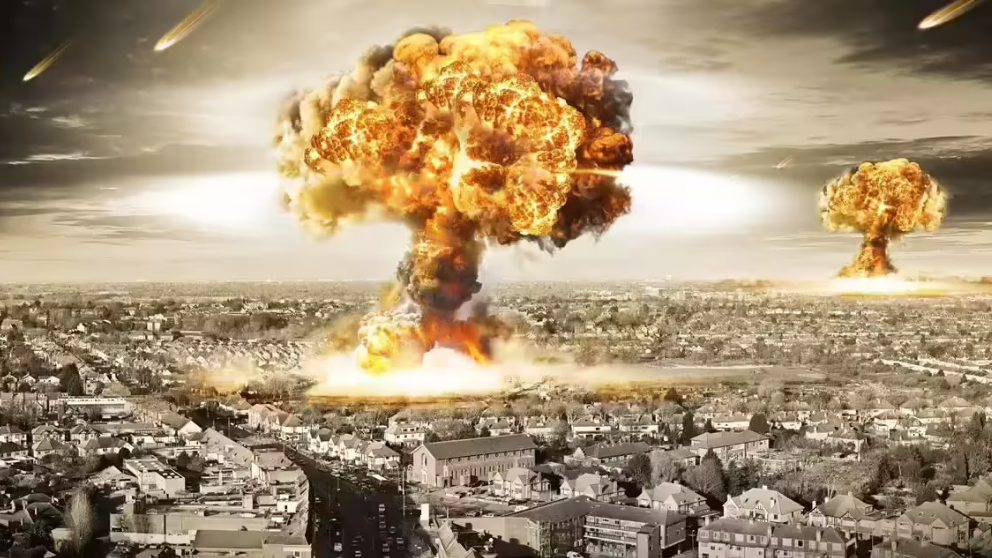
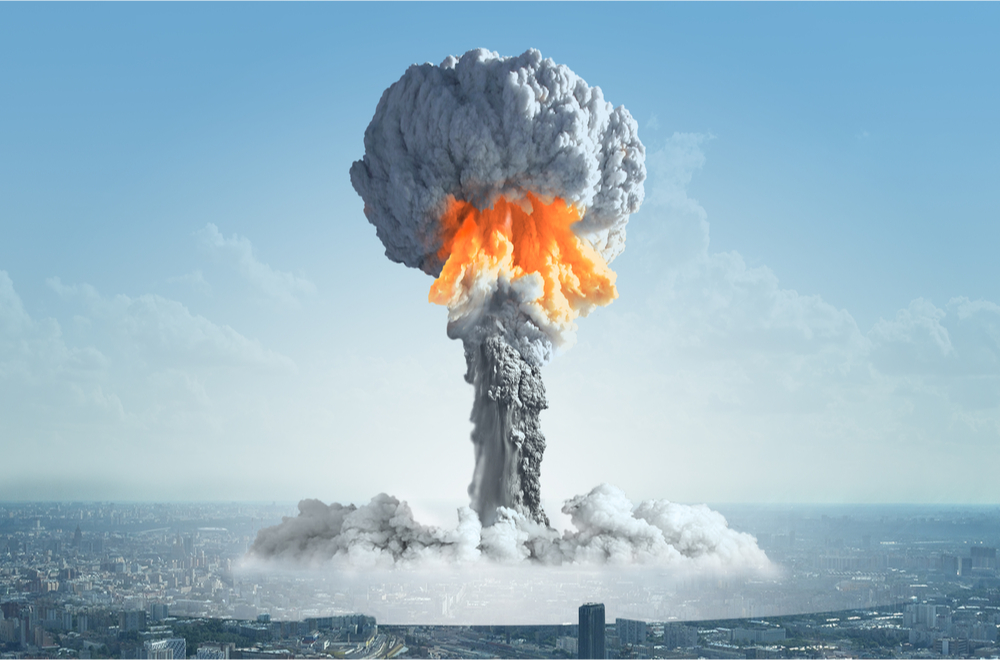
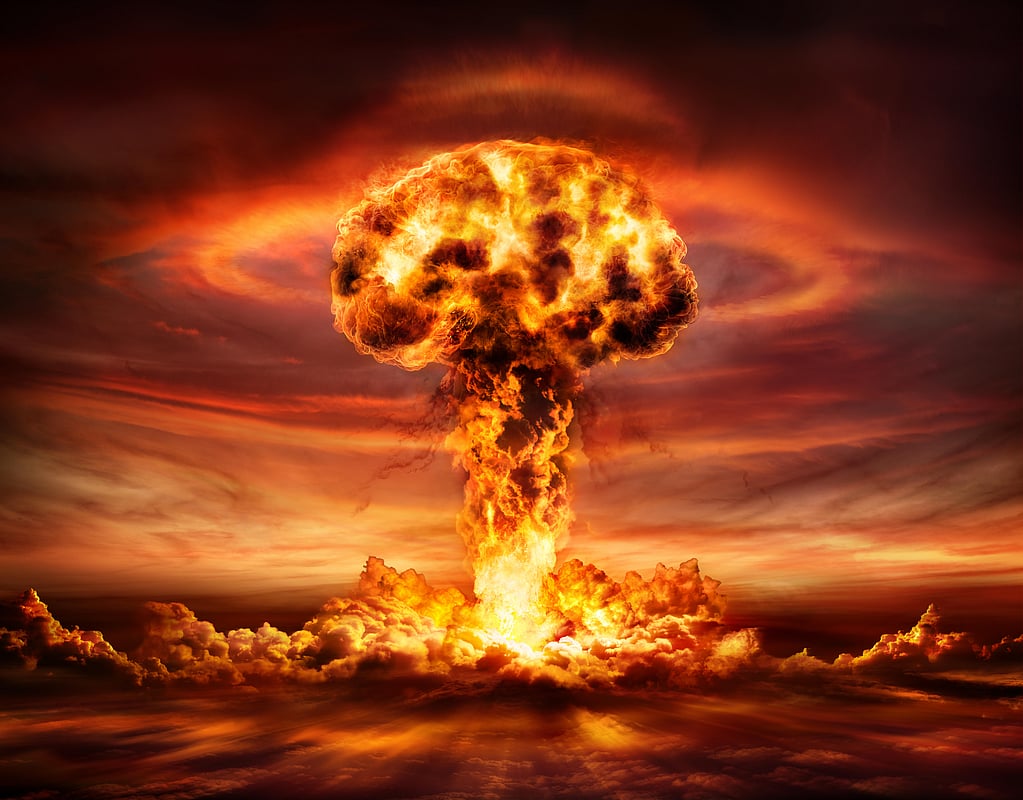
First, it creates a fireball that reaches temperatures of millions of degrees Celsius. This thermal heat radiation travels outward at the actual speed of light. This means that victims are burned by the intense heat before they can even hear the sound of the explosion. In Hiroshima and Nagasaki, this heat was so bright and intense that it permanently burned the shadows of people and objects right into concrete walls.
Right after the heat comes the blast wave. Because the air is heated so quickly, it violently expands outward faster than the speed of sound. This creates a high-pressure shockwave that is strong enough to completely flatten and destroy concrete buildings for miles. Research from the Radiation Effects Research Foundation shows that the combination of the insane heat and this crushing shockwave causes the vast majority of immediate deaths in a city strike.
On top of all this physical destruction, the blast releases an Electromagnetic Pulse (EMP). This invisible pulse would instantly fry and disable the silicon-based infrastructure of our modern electronics. Phones, internet, power grids, and cars would just shut down in the blink of an eye.
The Real Danger: What is a "Nuclear Winter"?
While the immediate explosion is horrific, the biggest long-term threat to humanity isn't the blast itself it’s what happens to the sky.
If cities in the Middle East were to burn due to a nuclear war, it would create an environmental nightmare known as a "nuclear winter." A study published in the scientific journal Nature Food revealed exactly how this would happen.
There’s more to life than simply increasing its speed.
By Udaipur Freelancer
The burning cities would release roughly 5 million tonnes of thick, black carbon soot straight up into the stratosphere. Normal smoke from a regular fire stays low and eventually gets washed away by rain. But this nuclear soot is pushed so incredibly high into the atmosphere that it sits above the clouds. Up there, there is no rain to wash it away.
Instead, high-altitude winds would catch this soot and carry it around the entire globe. It would create a dark shield wrapping around the Earth, absorbing sunlight and blocking it from reaching the ground.
Why the Whole World Goes Hungry
This brings us to the most terrifying point of all. Because the sun is blocked, the Earth would experience a sudden and drastic drop in surface temperatures.
Without warmth and sunlight, global agriculture would completely collapse. Crops would die in the fields. The Nature Food study points out that even a "limited" nuclear exchange just between Israel and Iran could reduce global food calories by an unbelievable 90 percent.
Think about that. Ninety percent of the world's food supply, just gone.
This would lead to a rapid, unstoppable famine. It wouldn't just affect the people in the Middle East. It would kill billions of innocent people who live thousands of miles away from the conflict zone simply because there would be no food left on Earth to eat.
The Invisible Killer: The Long Shadow of Radiation
If the cold and the hunger weren't enough, there is a third nightmare: ionizing radiation. This type of radiation has energy strong enough to literally rip electrons right off of atoms.
When an atomic bomb goes off near the ground, it acts like a giant vacuum. It sucks up huge amounts of dirt and debris and coats them in highly radioactive particles like Caesium-137 and Strontium-90. According to the International Campaign to Abolish Nuclear Weapons, these particles have long "half-lives." That is a scientific way of saying they don't fade away quickly. They will persist in the environment, poisoning the soil and local water supplies, for decades.
Just like the black soot, this radioactive dirt (known as fallout) is carried by winds across international borders. It doesn't respect maps or countries.
Eventually, these particles settle down into the dirt and water. From there, they enter the food chain. When humans consume contaminated food or water, these radioactive particles trick our bodies. Strontium-90, for example, acts and mimics calcium. So, human bodies absorb it directly into the bones, which leads to deadly diseases like bone cancer and leukemia.
Furthermore, the atomic bombings of Japan back in 1945 proved that radiation is a trans-generational poison. It actually damages human DNA. This means the survivors of the blast pass down permanent genetic mutations to their children and grandchildren.
Final Thoughts
A nuclear conflict is never just a local problem. The science makes it incredibly clear: if these weapons are used in the Middle East, the entire world will pay the price through a dark, freezing, and starving global nuclear winter.
As the article from India Today so chillingly put it. In the cold mathematics of nuclear war, the living will find themselves envying the dead, as the very sunlight that once sustained life becomes nothing but a memory of a vanished era. Let us hope that cool heads prevail, and these weapons remain securely locked away forever.















Recommended for you
Must-See Art Exhibitions Around the World This Year
The Revival of Classical Art in a Digital Age
Breaking Down the Elements of a Masterpiece Painting
The Revival of Classical Art in a Digital Age