Is history finally repeating itself? A deep look into why the latest moves from the US Secretary of State have the Global South looking over its shoulder and remembering the dark days of the East India Company.
If you take a moment to look back at the history books, the 18th and 19th centuries were a very specific time for the world. It was a time when European powers looked at the map of the world not as a collection of people and cultures, but as a pie to be sliced up and devoured. They raced for markets, they grabbed raw materials, and they built massive empires that spanned oceans. It wasn’t just about planting flags. it was about money, resources, and total dominance.
Fast forward to today. The flags have changed, the technology has advanced, and the methods are digital, but the language? According to many experts analyzing the recent Munich Security Conference, the language is starting to sound terrifyingly familiar.
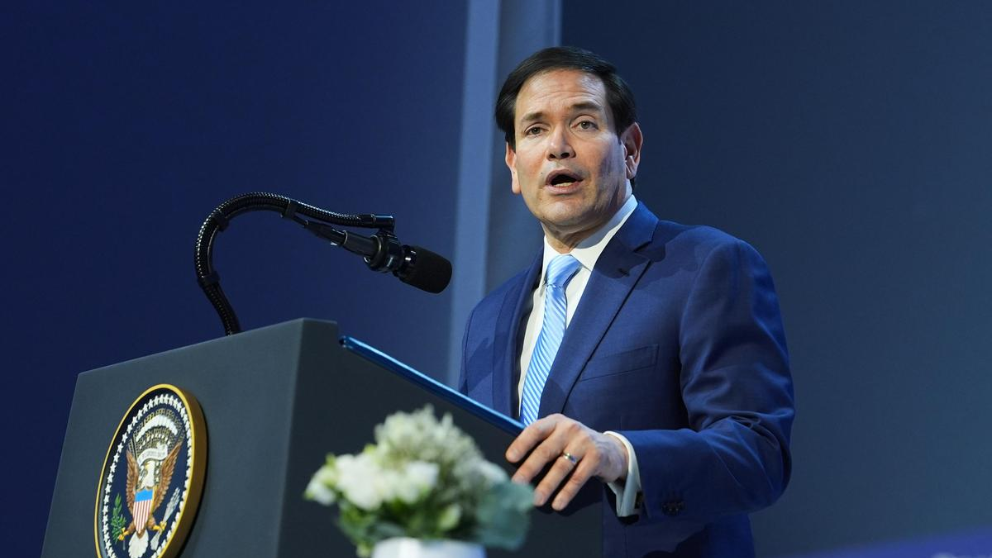
At this recent high-level gathering, US Secretary of State Marco Rubio gave a speech that didn’t just raise a few eyebrows it set off alarm bells across the entire developing world. He spoke of building a New Western Century. He spoke of competing for market share in the economies of the Global South. And perhaps most controversially, he spoke about civilization in a way that sounded like a history lecture from the 1800s.
For countries like India, as well as vast regions of Africa and Latin America, this wasn't just a standard diplomatic update or a policy shift. It sounded like a blast from the past specifically, the colonial past. In this post, we are going to take a long, hard look at exactly what happened, why experts are comparing modern US policy to the infamous East India Company, and what this actually means for the future of the Global South.
The Munich Speech: Decoding the Western Century
To truly understand the controversy that is brewing, we first have to look closely at the words coming out of Marco Rubio’s mouth. The Munich Security Conference is one of the most influential annual forums on foreign and security policy. It brings together hundreds of heads of state, ministers, military chiefs, diplomats, and policy experts to debate global security challenges. It is usually a place for polite, careful, and very measured diplomatic talk.
But this time, the tone was different. Rubio framed his entire vision as an effort to build a New Western Century. Now, on the surface, that might just sound like a patriot cheering for his team or a politician trying to rally his base. But when you dig deeper into the implications of that phrase, it implies that the West owns the century. It implies that other centuries Asian, African, Latin American are secondary or perhaps shouldn't exist at all in the same spotlight. He didn't speak about partnership or mutual growth. He spoke about regaining ground, as if that ground was lost property that needs to be recovered.
One of the most striking and revealing phrases Rubio used was the term market share. He explicitly called on the West to compete for market share in the economies of the Global South. Think about the weight of that phrase for a second. He isn't talking about these countries as sovereign nations with their own dreams, their own politics, and their own agency. He is talking about them as markets to be captured. It turns entire populations into customers and entire nations into shelf space.
Rubio went even further back in history to justify this worldview. He traced what he called the 'arc of Western power' all the way back to the end of World War II, and even further to the explorers of the past five centuries. He painted a picture where the West was expanding with its missionaries, its pilgrims, its soldiers, and its explorers pouring out from its shores. But then, he claimed, it started to contract.
And why did it contract? According to Rubio, this decline was accelerated by godless communist revolutions and this is the part that hurts by anti-colonial uprisings. He effectively framed the independence movements of the 20th century, where countries like India fought bloody battles for their freedom, as a period of decline for the West. He called it a retreat. This choice of words suggests that he views the liberation of colonies not as a victory for human rights or freedom, but as a loss for Western power.
The Ghost of the East India Company
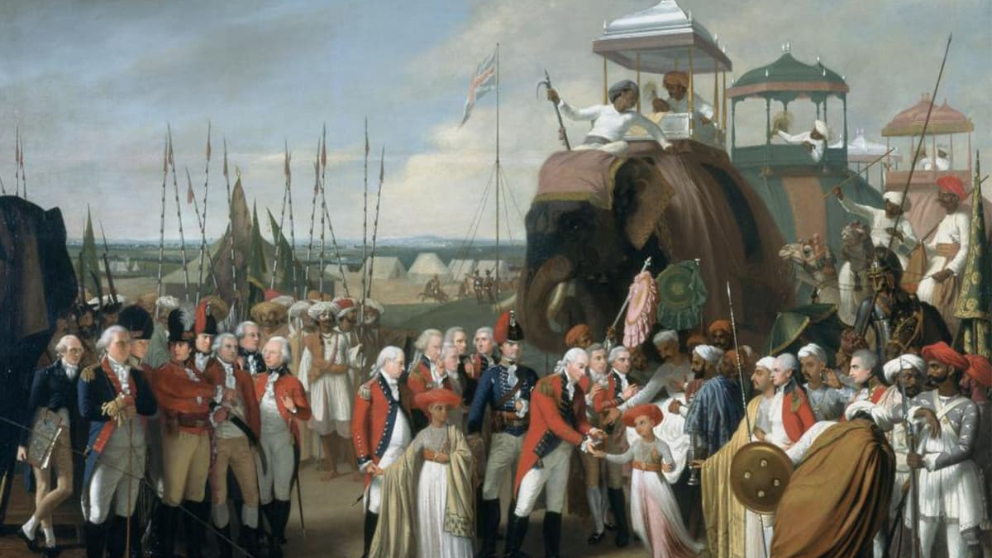
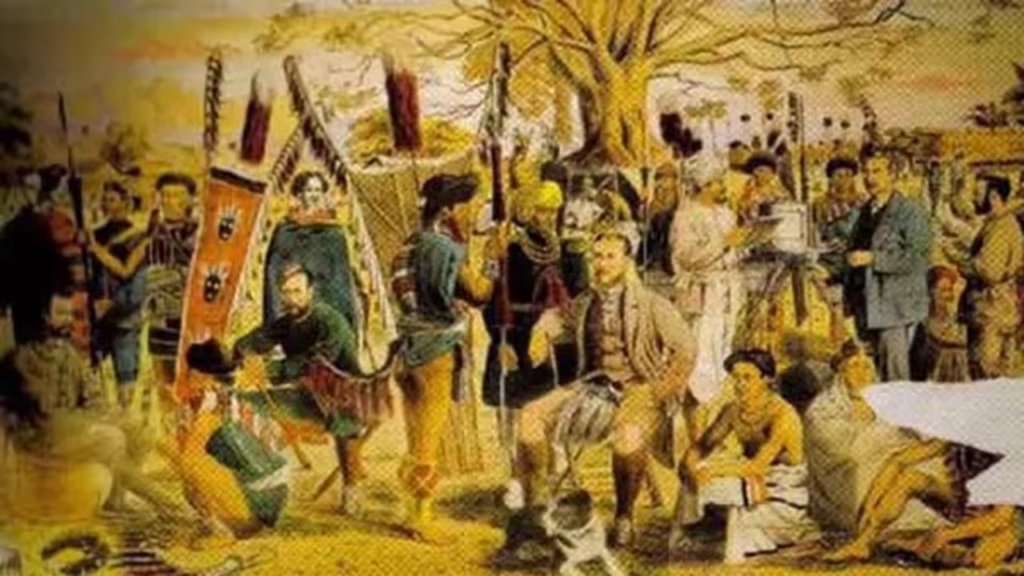
The most powerful and disturbing comparison emerging from this entire situation is the reference to the British East India Company. For those who might have skipped that chapter in history class, the East India Company wasn't just a business. It was a monster. It was a dangerously unregulated private company headquartered in a small office, five windows wide, in London. Yet, managed by what some historians call unstable sociopaths like Robert Clive, it managed to conquer the Indian subcontinent.
The East India Company didn't start with full-scale war. It started with trade. They came for spices and textiles. They built forts to supposedly protect their trade. They hired private armies. Eventually, they were collecting taxes, fighting wars, and running governments. The Company extracted resources from India and shipped them to Europe. They didn't build railways to help Indians travel. they built them to move troops and raw materials to the ports. It was wealth extraction on a massive, continental scale.
Now, critics are looking at the Trump administration and arguing that they are raising a 'New East India Company.' The focus is once again on resources and control rather than democracy and freedom. Rubio’s speech emphasized creating a Western supply chain for critical minerals. He wants to ensure these minerals which are found mostly in the Global South are not controlled by rivals.
Just like the East India Company wanted absolute control over cotton and spices, the modern Western powers want control over lithium, cobalt, rare earth elements, and oil. The goal is to secure the supply chain for the West, regardless of what the local countries actually want. It places the Global South explicitly within a competitive framework. In this view, developing nations are not partners at the table, they are the prize on the table to be won or lost.
Europe’s Child Leads the Charge
There is a fascinating historical twist happening right now. In the old days, it was Europe specifically Britain, France, and Spain that led the colonial charge. The United States was actually a colony itself that broke away. But now, the roles have completely reversed. Rubio’s speech was described by analysts as Europe’s Child, meaning the USA, urging the Mother, meaning Europe, to march along.
The United States is effectively telling Europe that they need to get the band back together. They are saying that they need to go back out there and take control of these markets. Rubio sought the help of European allies in Munich, explicitly stating that together they can not only take back control of their own industries and supply chains but can prosper in the areas that will define the 21st century.
The phrase take back control is very heavy with meaning. You can only take back something you think you owned in the first place. This is why experts like Debabrata Bhaduri, a Kolkata-based global security analyst, reacted with such shock. He called Rubio’s address insane and stated that the US Secretary of State just gave one of the most explicitly pro-colonialist speeches seen in the 21st century. The interpretation is that the US Empire wants Europe to help it recolonize the Global South. It is a strong accusation, but when you look at the language used terms like regaining ground, market share, and civilizational restoration it is very hard to ignore the colonial undertones.
Economic Warfare and The Oil Game
It is not just about speeches; it is about action. The analogy of the New East India Company holds up even stronger when you look at how the US is handling global trade, specifically regarding energy. We are seeing a prime example of modern economic maneuvering that feels exactly like old-school imperialism in the triangle between the US, Venezuela, and India.
The Trump administration has been treating US foreign policy almost like a family enterprise, similar to how the East India Company was a private venture. Reports suggest a crypto council stacked with family members inked deals, such as one involving the alleged kidnapping of Venezuela's President Nicolas Maduro. After effectively taking control of Venezuela's energy trade, the US is now trying to dictate who buys that oil.
This is where India comes into the picture. India has been buying crude oil from Russia because it makes economic sense for India's energy security. The US does not like this. So, the administration is trying to dictate global trade by pressuring New Delhi to stop buying Russian oil and instead buy Venezuelan oil, oil that the US now effectively controls.
By forcing India to buy from a source that the US controls, the US is trying to dictate India's foreign policy. India has asserted that its energy security will determine its oil trade and partners, essentially saying that they will do what is best for their people. But the US approach treats India not as a sovereign nation that can choose its partners, but as a subsidiary that must follow the head office's rules. This is exactly how the East India Company operated, dictating who could trade with whom to ensure maximum profit for London.
There’s more to life than simply increasing its speed.
By Udaipur Freelancer
The Civilizational Dog Whistle
One of the most disturbing aspects of Rubio’s speech for many listeners was the intense focus on civilization. Rubio didn't just talk about money or security. He said that "we are part of one civilization, the Western civilization." This framing is incredibly dangerous because it creates an Us vs. Them mentality.
Geopolitical expert Brahma Chellaney pointed out that by framing the future through the lens of identity and civilizational restoration, Rubio is doing something that echoes themes found in White supremacist discourse. In simple terms, it creates a global hierarchy. At the top, you have Western Civilization, the so-called Great Empires. At the bottom, you have the Global South, the places to be extracted from.
Chellaney wrote that the vision Rubio outlined does not just seek a balance of power. rather, it seeks the restoration of a global hierarchy that is inherently exclusionary and reminiscent of earlier eras of European imperialism and Western hegemony. When Rubio listed the reasons for the West's decline, he blamed anti-colonial uprisings. Think about how insulting that is to a country like India, or Kenya, or Vietnam. These nations celebrate their independence movements as their proudest moments. They celebrate throwing off the chains of empire. For the US Secretary of State to frame those uprisings as a negative event that caused the contraction of the West shows a complete lack of respect for the history of the Global South. It suggests that the natural order of things is for the West to rule, and independence was a mistake.
Reactions from the Global South
The reaction to Rubio’s speech has been sharp, swift, and unforgiving. The Global South is not the same as it was in the 1800s. These are powerful, sovereign states today. They have a voice, they have power, and they have options.
Author and commentator Sanjaya Baru did not mince words when he said India should condemn this speech with the contempt it deserves. He called it an 'antediluvian Western Project.' The word antediluvian means remarkably old-fashioned or before the flood. Baru is essentially saying that Rubio is living in the past, thinking that we are still in the era of sailing ships and emperors.
French entrepreneur and geopolitical commentator Arnaud Bertrand also weighed in, stating that it is one of the most revisionist and imperialist speeches he has ever seen a senior American official make. Bertrand explained that Rubio wants to restore the building of vast empires extending across the globe and actually blames the people who fought for their freedom for ruining it.
Even US-based investigative journalist Jason Zaharni said Rubio’s address should completely erase any notion that the Western bloc is civilized or ever upheld the principles of international law, democracy, or freedom. The mask, according to these critics, has slipped. It is no longer about bringing democracy to the world. It is about bringing control.
Market Competition vs. Colonization
Some people might try to argue that this is just business. They might say, "Isn't competition good? Isn't Rubio just saying the US needs to compete in business?" Yes, there is a difference between healthy market competition and colonization. But the line gets very blurry when you look at the methods and the goals involved here.
Healthy competition is saying, "I have a better product, so you should buy it." Colonization is saying, "I control the supply chain, I control your government's choices, and I demand you trade only with me." Rubio wasn't just talking about selling iPhones or cars. He was talking about regime change, territorial control over the flow of goods, and strategic leverage.
Rubio mentioned industrial policy and economic leverage. In the colonial era, trade was the fulcrum the tool used to pry open countries. Today, trade is still the tool. The difference is that in the 1800s, it was the British Navy enforcing the trade. Today, it is sanctions, banking systems, and supply chain security. The method has changed, but the language remains surprisingly similar.
The Trump Family Enterprise
Another fascinating point raised in the analysis of this situation is how the Trump administration operates. The text compares it to a family enterprise. It mentions a crypto council stacked with his family members that inked deals without wider consultation. This informal, centralized style of decision-making reminds historians of the East India Company.
The East India Company wasn't a government, it was a private board of directors making decisions that affected millions of lives. When foreign policy becomes privatized and driven by a small inner circle rather than democratic consensus and international law, it becomes dangerous. It leads to decisions that benefit the company or in this case, the administration rather than the world.
Why This Matters to You
You might be reading this and thinking that this is high-level politics that doesn't affect your daily life. But that couldn't be further from the truth. This New Western Century mindset affects everything.
If the West tries to monopolize supply chains for things like lithium, which is used in your phone and electric car, prices could skyrocket due to trade wars. Furthermore, aggressive language about regaining ground usually leads to conflict. If the West pushes too hard, the Global South countries like China, Russia, India, and Brazil will push back.
Most importantly, it is about global fairness. If you believe in a world where every country has the right to decide its own future, this rhetoric is terrifying. It suggests a return to a world where might makes right. But the biggest flaw in Rubio’s plan is that he seems to think the Global South is just waiting to be reconquered. As the experts note, unlike the colonial era, Global South countries today are powerful sovereign states. They negotiate. They diversify partners. They pursue their strategic autonomy.
India, for example, is not going to just bow down. It plays the US, Russia, and China against each other to get the best deal for its people. They are not passive territories waiting to be divided. They are players in the game.
Conclusion: A Step Backward?
Marco Rubio’s speech at the Munich Security Conference was more than just words. It was a clear signal. It signaled that the US, under the Trump administration, views the world not as a community of nations, but as a marketplace to be dominated. It views history not as a march toward freedom, but as a loss of Western control that needs to be fixed.
The comparisons to the East India Company are strong because the themes are the same. It prioritizes dominance over partnership, extraction over development, and a specific view of civilization over equality. History tells us that when the West speaks of regaining market share in the Global South, the shadow of colonization is never far behind. The question now is whether the Global South will accept this New Western Century, or if they will stand together and say that they have seen this movie before, and they know how it ends.












Recommended for you
Must-See Art Exhibitions Around the World This Year
The Revival of Classical Art in a Digital Age
Breaking Down the Elements of a Masterpiece Painting
The Revival of Classical Art in a Digital Age