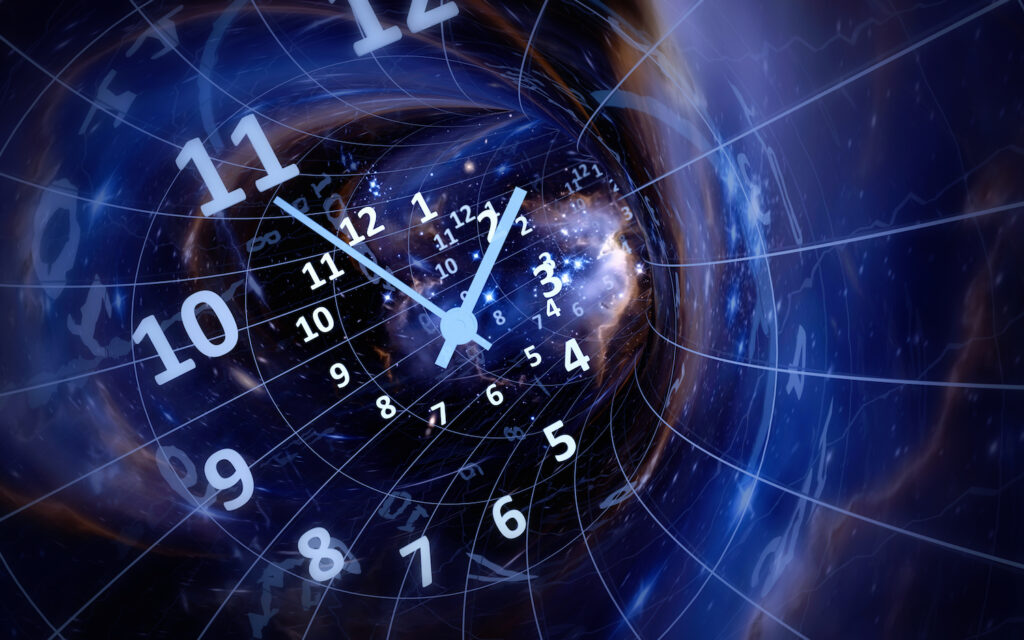
For decades, the concept of time travel was relegated to the imaginative realms of science fiction, yet modern physics suggests that the fourth dimension is far more flexible than our daily experiences lead us to believe. At the heart of our current understanding is Albert Einstein’s Theory of Relativity, which fundamentally dismantled the idea of time as a universal constant. We now know that time is relative and inextricably linked to space, forming a four-dimensional fabric known as spacetime. According to Special Relativity, time dilation is a proven physical reality. the faster an object moves through space, the slower it moves through time relative to a stationary observer. This means that astronauts aboard the International Space Station are technically time travelers, returning to Earth having aged slightly less than those on the ground, proving that traveling into the future is not just possible, but an inevitable consequence of high-speed motion.
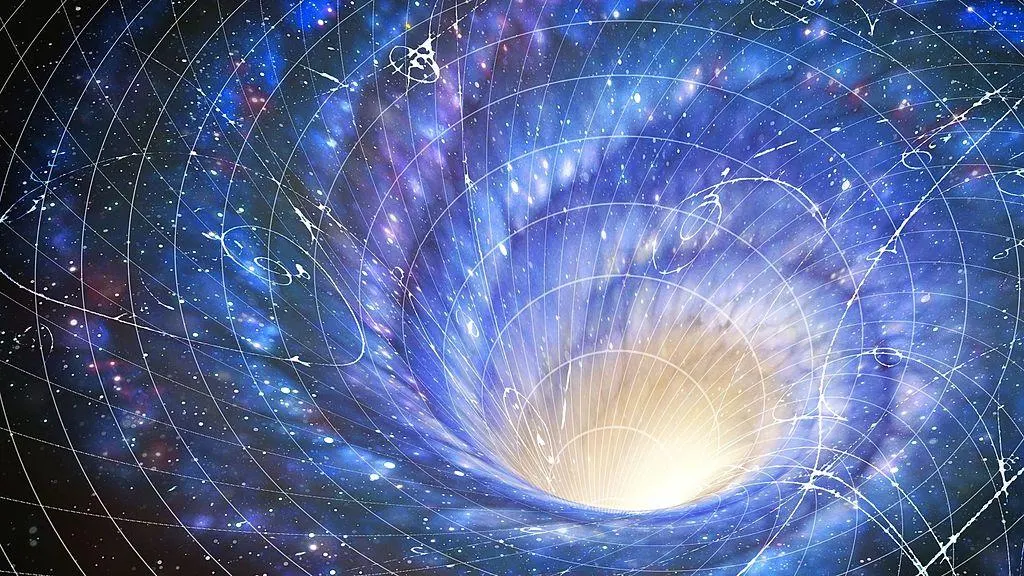
General Relativity takes this concept even further by introducing the influence of gravity on the passage of time. Massive objects, such as planets, stars, and black holes, warp the fabric of spacetime, causing time to tick more slowly in stronger gravitational fields. This gravitational time dilation means that if you were to hover near the event horizon of a massive black hole and then return to Earth, decades or even centuries could have passed for the rest of the world while only hours passed for you. This one-way time travel into the future is mathematically sound and experimentally verified, yet the quest for backward time travel remains the ultimate challenge for contemporary theorists.
To journey into the past, physicists look toward more exotic and speculative phenomena, such as Closed Timelike Curves or CTCs. These are theoretical paths through the geometry of spacetime that loop back on themselves, potentially allowing an object to meet its past self. One of the most famous proponents of this idea was Kurt Gödel, who discovered that a rotating universe could theoretically allow for such loops. More modern theories involve the concept of wormholes shortcuts through spacetime which, if stabilized by a hypothetical substance known as exotic matter with negative energy density, could act as a bridge between two different points in time. While the math allows for these structures, whether the laws of quantum mechanics permit them to exist in reality remains one of the greatest debates in the field.
The most significant barrier to backward time travel is the existence of logical paradoxes, the most famous being the Grandfather Paradox, where a traveler prevents their own birth. To resolve these contradictions, physicists have proposed several intriguing models. The Novikov Self-Consistency Principle suggests that the laws of physics would naturally prevent any action that creates a paradox, essentially making the timeline unbreakable and ensuring that any past intervention was already a part of history. Alternatively, the Many-Worlds Interpretation of quantum mechanics suggests that traveling to the past might actually involve entering a parallel timeline or a branching universe, where your actions have no effect on the original reality you left behind.
There’s more to life than simply increasing its speed.
By Udaipur Freelancer
Despite these fascinating possibilities, many physicists, including the late Stephen Hawking, remained skeptical about the feasibility of traveling to the past. Hawking proposed the Chronology Protection Conjecture, which suggests that the laws of physics conspire to prevent closed timelike curves, perhaps through vacuum fluctuations that would destroy a wormhole the moment it formed. He famously pointed out that the lack of tourists from the future is a strong indication that backward time travel may never be mastered. Nevertheless, the study of time travel remains a vital pursuit in modern physics, as it pushes the boundaries of our knowledge and forces us to reconcile the grand scale of General Relativity with the mysterious, microscopic world of Quantum Mechanics.















Recommended for you
Must-See Art Exhibitions Around the World This Year
The Revival of Classical Art in a Digital Age
Breaking Down the Elements of a Masterpiece Painting
The Revival of Classical Art in a Digital Age