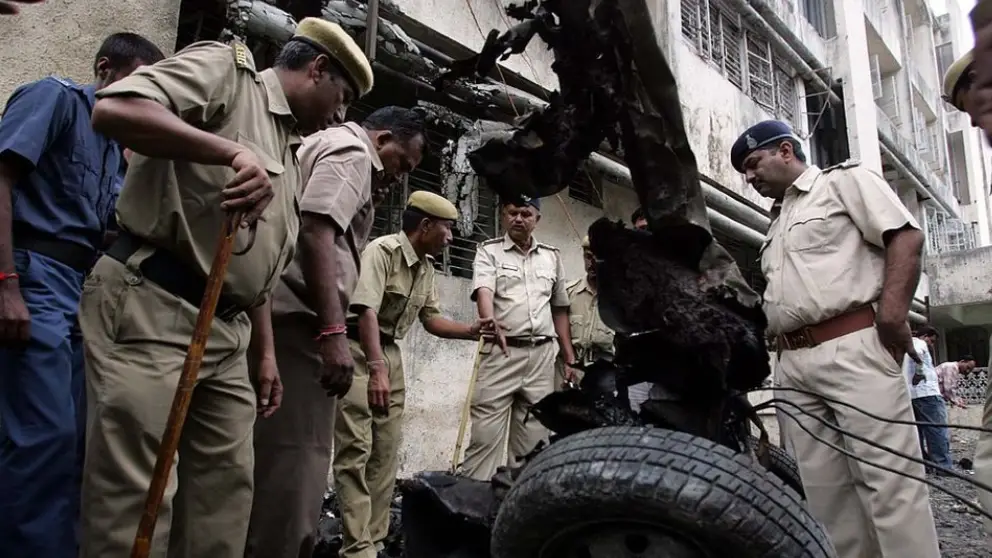
The Gujarat High Court recently confirmed the death penalty for 38 people. These individuals were found guilty of planning and executing the tragic 2008 serial bomb blasts in Ahmedabad and Surat. The attack, which took place on July 26, 2008, shook the entire nation. It killed 56 innocent people and left many others wounded. The bombs went off in 22 different places across Ahmedabad within a very short span of time.
But what shocked the public and investigators the most was the background of the accused. They were not common criminals from the streets. Instead, the list of those facing the gallows includes a highly educated journalism student, a religious teacher, and a regular local trader. This mix of professional and educational backgrounds has made many people wonder how such educated individuals got involved in such a dark conspiracy.
The Leaders and Their Backgrounds
Among the key people facing the death sentence is Safdar Nagori, who is from Ujjain. Nagori was the former chief of the banned group Students Islamic Movement of India (SIMI). Interestingly, Nagori held a degree in journalism. Police records identify him as the "principal organiser" of the terror network. He did not just write or speak; he allegedly ran training camps in the forests of Kerala and Karnataka to recruit and train young people.
Another main figure in the network was Mufti Abu Bashir, from Azamgarh. Bashir was a madrasa teacher. The investigation found that he acted as the "ideological force" behind the group. He used his position as a teacher to influence minds and provide the religious justification for the attacks.
Then there were people who helped with the everyday logistics. Qayamuddin Kapadia, a trader from Vadodara, and Sajid Mansoori, a marketing professional from Bharuch, provided crucial support in Gujarat. They helped buy materials, find places to hide, and transport items without raising suspicion. Their normal daily jobs served as a perfect cover for their illegal actions.
The Indian Mujahideen, the group responsible for these acts, had created a network that was spread across six different states in India. By bringing together people from different walks of life, they hoped to operate under the radar of the police. A simple trader going about his business or a marketing professional meeting clients did not raise any red flags. This shows how deeply planned the entire operation was, relying on everyday citizens to carry out deadly tasks.
The Tech Experts and Bomb Makers
The conspiracy also had a strong technical side. Investigations showed that a Maharashtra-based group was in charge of assembling the bombs. This group included Mohammad Akbar Ismail Chaudhari, who was a computer and IT expert, and Aasif Hasan Sheikh. Both of them belonged to Pune, a known IT hub.
There’s more to life than simply increasing its speed.
By Udaipur Freelancer
It is deeply disturbing to see how modern skills were used for destruction. Today, we talk about amazing digital progress, such as when India opens the 6GHz spectrum for WiFi 6E to make our lives faster and better. However, back in 2008, these technical minds used their knowledge of electronics and circuits to build deadly explosive devices. They used ammonium nitrate and fuel oil (ANFO) to create bombs that could kill dozens of people at once.
The Hospital Bombing and the Investigation
Perhaps the most heartless part of the attack was the bombing at the Ahmedabad Civil Hospital. Afzal Usmani, who came from Mumbai, allegedly drove a stolen car filled with explosives into the hospital's trauma centre parking lot. Mumbai has always been a busy city, often dealing with natural events like a red alert due to heavy monsoon rain. But this human-made disaster was far worse than any storm.
The bomb at the hospital was timed to explode after the first blasts had occurred elsewhere. As injured victims, worried relatives, doctors, and rescue workers rushed to the trauma centre, the car bomb went off. This single blast killed 37 people. It also damaged the city's main emergency response system, making it very hard to treat those who were already hurt from the earlier blasts.
The investigation took years of hard work. The police had to track phone calls, rent agreements, and stolen vehicles across multiple state borders. Ashish Bhatia, who led the investigations as the Joint Commissioner (Crime) in 2008, mentioned that his team had to be extremely precise. Finding the bomb factory in Dani Limda was the breakthrough they needed. It proved that the conspiracy was not just local but had a massive backing with high-quality chemical mixtures prepared in secret urban laboratories.
A Warning from the Past
The court's decision to confirm the death sentences brings some peace to the families of the victims who lost their lives on that terrible day. However, it also serves as a strong warning. It shows that extreme ideas can affect anyone, regardless of their job, education, or social standing. Whether it is a teacher, a journalism student, a tech expert, or a trader, the law will eventually catch up with those who seek to harm innocent lives.














Recommended for you
Must-See Art Exhibitions Around the World This Year
The Revival of Classical Art in a Digital Age
Breaking Down the Elements of a Masterpiece Painting
The Revival of Classical Art in a Digital Age